
You're not looking for another broad CRM explanation. Most real estate organizations already understand the value of Salesforce. The more important question is how to turn that investment into a controlled operating model that generates the right documents, routes them through the right approvals, and keeps every transaction record aligned from first inquiry through close.
That is where salesforce real estate becomes more than a database. It becomes the foundation for document-driven execution. When structured record data feeds listing materials, proposals, lease packets, contracts, receipts, investor updates, and recurring reports, teams move faster with less manual work and fewer avoidable errors.
In that model, Salesforce is not just the place where activity gets logged after the fact. It is the system that triggers the work itself.
Real estate firms operate through documents. Brokerage teams produce listing packages and transaction summaries. Leasing teams manage proposals, renewals, and lease documentation. Property teams generate owner updates, inspection reports, receipts, and recurring operational summaries. Investment teams need consistent outputs for reviews, approvals, and stakeholder reporting.
The operational issue is rarely a lack of data. It is the gap between stored data and usable business output.
When that gap remains manual, the same problems appear repeatedly:
Salesforce's real-estate CRM positioning is built around a single source of truth across the client lifecycle, with customer, property, and transaction data centralized for brokers, agents, and property teams. That foundation matters, but the greater business value comes when the same records also control document generation, routing, and status updates.
For teams that still run prospecting in parallel systems, a practical pairing is a lifecycle system in Salesforce plus a direct-mail motion. The important part is that outbound activity, response history, and document follow-up stay connected to the same deal record.
In real estate, the system of record becomes significantly more valuable when it also governs the documents people use to move work forward.
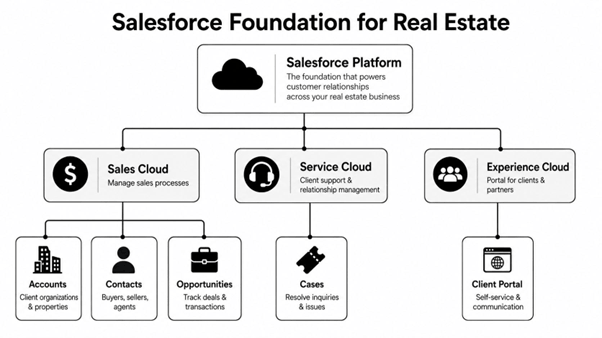
A strong real estate Salesforce model still starts with core records such as Accounts , Contacts , and Opportunities , but the document operating model usually depends on additional objects such as Property , Listing , Lease , Unit , tenant records, and transaction-specific custom objects.
Those records are not important just because they make the architecture more complete. They matter because they determine whether the business can generate accurate output without manual cleanup.
The most practical test is simple. Can the team generate the required document directly from the record and trust what comes out?
If a property record does not maintain the right related contacts, a listing presentation requires editing. If a lease object does not hold milestone, pricing, and occupancy details correctly, proposal generation becomes unreliable. If transaction stages do not reflect the actual approval path, contract generation and follow-up lose credibility.
That is why record relationships, field governance, and stage discipline matter so much in real estate. The strongest implementations preserve asset history, pricing changes, stage movement, key contacts, and related activities so the system can feed controlled templates instead of forcing teams to rebuild the transaction manually.
In a document-first model, the main role of Salesforce is not to impress users with a long feature list. Its real value is that it creates controlled trigger points for generation, review, delivery, and status updates.
A workflow can take approved record data and generate listing packets, leasing proposals, contracts, client updates, receipts, or investor reports without rekeying. The Salesforce document generation example shows how CRM data can flow into generated outputs while staying tied to the originating records.
The most valuable automation opportunities are rarely the most complex. They are the repetitive document events that shape daily execution across brokerage, leasing, property management, and investment operations.
Brokerage teams often need to create listing presentations, property summaries, transaction packets, client updates, and marketing-ready materials under tight timelines. When these outputs pull directly from maintained property, contact, and deal data, teams reduce repetitive editing and avoid version drift.
This also improves management control. Leaders can see not only which opportunities are active, but also whether required materials have been generated, delivered, and attached to the correct records.
Leasing operations are highly document-intensive. Proposal documents, draft lease summaries, renewal notices, occupancy updates, amendment packets, and approval documents all depend on accurate unit, tenant, and pricing data.
This is where weak record design becomes visible quickly. Mixed portfolio modeling becomes especially important when residential, commercial, and industrial records do not follow the same workflow shape.
Property teams regularly need to generate owner reports, internal operating summaries, inspection outputs, receipts, and recurring status updates. These are exactly the kinds of workflows that benefit from standardization.
Instead of building reports manually at the end of each cycle, teams can generate them directly from maintained records and related data. The automated property report generator guidance is a useful example of how these workflows can be standardized.
The highest-value automation usually begins with documents the business already creates every week and cannot afford to get wrong.
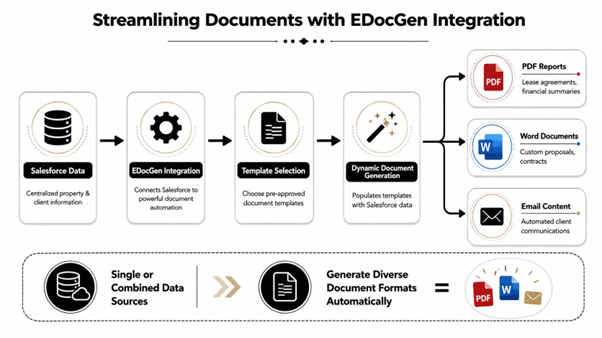
A Salesforce real estate deployment becomes substantially more useful when document generation is embedded directly into execution. Listing presentations, proposals, contracts, receipts, reports, and client communications should come from CRM data and related objects, not from disconnected files that drift away from the source record.
The best automation patterns remove work from the user instead of adding more process overhead.
A practical example begins with a business event. An employee completes an online form built from a template, EDocGen generates the presentation in PowerPoint format, the file is sent by email to the assigned sales rep, and Salesforce creates a new opportunity in the Investment Level stage at the same time. The document link remains tied to the opportunity in Salesforce, and sales reps can create presentations in under 60 seconds according to the case study material EDocGen case study .
That is the kind of process users adopt because it reduces friction. The user is not entering the same information twice. The template is not separated from the transaction. The generated document, trigger event, and pipeline update remain part of the same governed workflow.
Real estate organizations rarely need a single output format. The same transaction may require a presentation for internal review, a PDF for compliance or client delivery, a DOCX file for edits, and an email summary for follow-up.
EDocGen's Salesforce document-generation capability supports PDF , DOCX , XLSX, and PPTX output from Salesforce data, with pre-built Salesforce connectors that keep generation tied to the records already in use.
That matters because one-off scripts usually solve only one scenario. They may generate one file type, from one source, for one team, then become difficult to maintain when templates evolve, approvals change, or the record model expands. A connector-based approach is easier to scale and easier to govern.
Teams that need structured output at scale can use EDocGen's real estate document automation solution to keep generation, routing, and record updates in one process.
A scalable Salesforce real estate architecture should be evaluated by how well it supports reliable document workflows across the portfolio. The data layer still matters, but the practical question is whether the environment can generate, route, track, and govern the outputs the business depends on every day.
Mixed property portfolios reveal process issues early. Property, unit, lease, and tenant relationships often need different handling, and those differences directly shape which templates can be generated, when approvals should fire, and how records should be updated after delivery.
Standard Sales Cloud can support a great deal, but it is not automatically excellent as a property-management platform. The data model has to carry the business logic that document workflows rely on.
A sensible architecture typically makes the following decisions explicit:
Real estate organizations rarely operate in a single system. That is why document generation is also an integration question.
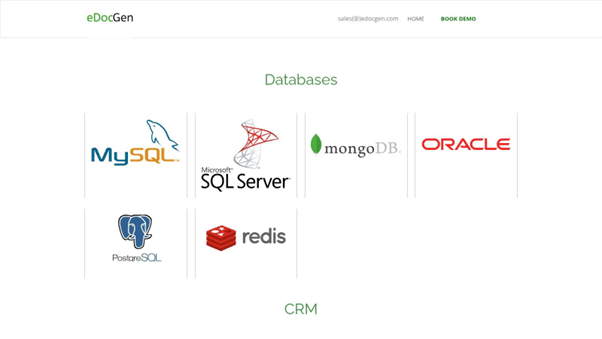
If templates, routing, approvals, and record updates live in disconnected tools, each change becomes harder to control. A connector-based approach keeps those actions tied to the same Salesforce workflow, including EDocGen integrations.
The architectural benefit is not just convenience. It is control. When generated documents stay linked to the right records and the workflow updates Salesforce automatically, the business gains a cleaner audit trail, fewer manual handoffs, and stronger consistency across teams.
A Salesforce investment in real estate has to deliver measurable operational value. The business case can sound broad, but the clearest returns usually come from document-intensive process improvements such as faster turnaround, fewer manual touchpoints, lower error rates, and stronger consistency across teams.
The measurement framework should remain practical:
The larger point is straightforward. Salesforce real estate becomes more valuable when the platform serves as the engine for record-driven output, not just as the database behind the scenes. That means the property model, trigger events, templates, approvals, routing rules, and integrations should be designed together. A platform like EDocGen fits that model by handling document generation as part of the operating process, not as a disconnected step at the end.