Background
In enterprise B2B sales, speed and personalization are often the deciding factors between winning a deal or losing momentum to a competitor. Yet, for many high-growth sales organizations, a major bottleneck exists right at the finish line: the creation of tailored client presentations.
Marketing teams invest heavily in designing compliant, high-converting PowerPoint templates. However, once those templates are passed to the field, sales representatives spend hours manually copy-pasting client logos, names, financial metrics, and specific pain points into individual slides. This manual process introduces formatting errors, risks brand inconsistency, and keeps sales reps bogged down in administrative work instead of pitching to clients.
This case study examines how an enterprise B2B sales organization partnered with EDocGen to automate sales presentations from PowerPoint templates , transforming a sluggish manual process into an on-demand, self-service workflow that cut deck preparation time from hours to under sixty seconds.
The Challenge: The Friction Between Brand Control and Customization
The marketing team owned the brand and the master template, but turning that template into dozens of one-off, customer-specific decks every week meant constant, repetitive manual work.
The organization faced a classic operational disconnect between its centralized marketing department and a distributed, fast-moving sales team.
The marketing manager had meticulously designed a robust master PPTX deck reflecting the company's latest branding, messaging, and product visuals. However, every prospective client required a localized, highly personalized pitch. A generic deck never closes deals — every customer conversation calls for a presentation tailored with the prospect's name, product, pricing tables, and the right case studies.
With hundreds of active deals across the pipeline, this manual overhead cost the company thousands of collective hours in monthly productivity. More importantly, it delayed the delivery of critical sales assets to hot leads, directly lengthening the enterprise sales cycle. The organization needed a solution that would preserve marketing's creative control while giving sales the agility to generate personalized assets instantly.
The Solution: On-Demand Slide Personalization via Form-to-PPTX Automation
The team turned to EDocGen to turn their existing PPTX template into a self-serve generation workflow. The setup took three steps:
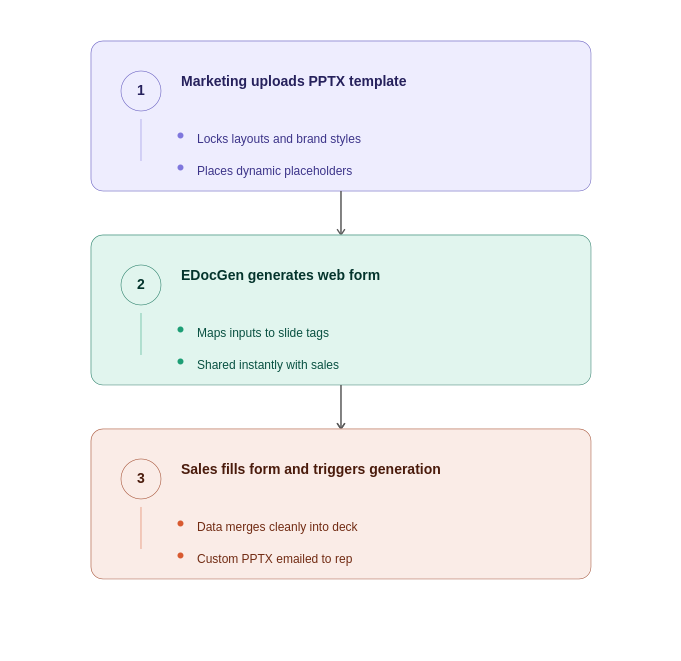
Phase 1: Template Preparation and Dynamic Tagging
The marketing manager uploaded the standard corporate PPTX template directly into the EDocGen platform. Instead of rebuilding the deck from scratch, they simply embedded placeholders—or "tags"—directly into the existing slides where personalized information belonged.
Tags like
{Client_Name}
,
{Industry_Focus}
,
{Target_Pain_Point}
, and
{Proposed_Pricing}
were positioned within the native text frames. Because EDocGen respects the
underlying formatting of the source PowerPoint file, all original styles,
font weights, colors, and spatial positioning were automatically locked in
place. Similar tags are added for dynamic population of tables, images.
Also, slide content was shown/hidden based on conditional statements added
to template.
Phase 2: Instant Form Generation
Once the template was uploaded, EDocGen scanned the presentation for these dynamic placeholders. The platform automatically generated a clean, structured online form matching the required fields.
This eliminated the need for custom frontend development or engineering resources. The marketing manager could configure input types (such as text fields, dropdown menus, or checkboxes) to guide the sales team's data entry. Once finalized, a secure, shareable web link to the form was distributed to the global sales team.
Phase 3: Friction-less Sales Execution and Delivery
With the new workflow in place, a sales representative prepping for an upcoming client pitch no longer opened PowerPoint. Instead, they opened the EDocGen web form.
The rep filled out the specific fields with the prospect's data, hit submit, and the platform's generation engine took over. In the background, EDocGen precisely injected the form data into the corresponding presentation placeholders, rendered a flawless, individualized PPTX file, and immediately dispatched it to the sales rep's inbox via automated email.
The Results: Scale, Speed, and Flawless Execution
• Sales velocity: Reps no longer wait on marketing for a custom deck — a presentation is ready within seconds of submitting the form, right before a call if needed.
• Brand consistency at scale: Every generated deck inherits the same approved layout, fonts, and design — removing the risk of off-brand or visually broken slides reaching a customer.
• Marketing bandwidth reclaimed: The team updates the master template once when pricing or messaging changes, instead of editing dozens of individual decks.
• No technical lift: Both the form creation and the generation logic are handled inside EDocGen — no custom development, scripting, or IT involvement needed to stand up or maintain the workflow.
Implementing the form-to-presentation pipeline yielded immediate, measurable improvements across operational efficiency, brand alignment, and sales velocity.
| Metric Evaluated | Before EDocGen | After EDocGen Implementation |
|---|---|---|
| Presentation Prep Time | 30 - 45 minutes per deck | Less than 60 seconds |
| Brand Compliance Rate | Low (Frequent broken layouts) | 100% Guaranteed Compliance |
| Sales Rep Training Required | Extensive template alignment rules | Zero training (Simple form completion) |
| Time-to-Inbox Delivery | Manual compilation and review | Instant automated email dispatch |
Why It Works
The strength of this approach is the separation of roles it creates. Marketing keeps ownership of design, structure, and messaging by maintaining a single source-of-truth template. Sales keeps ownership of the customer relationship, supplying only the details that change deal to deal. EDocGen sits in between, doing the repetitive merge work that previously consumed hours of manual effort across both teams every week.
The same pattern extends well beyond presentations. Any document that combines a fixed, branded structure with variable, deal-specific details — proposals, quotes, contracts, onboarding kits — can run through the same upload-form-generate workflow, making this less a one-off fix and more a reusable model for how the business produces customer-facing documents going forward.
The strategy of converting complex layout files into intuitive web forms offers a scalable blueprint for any organization looking to accelerate its sales pipeline, protect its brand identity, and optimize field productivity.
Ready to Automate Your Presentation Workflows?
Discover how easy it is to convert your master PowerPoint decks into self-service assets with EDocGen.
Schedule a Demo