
Think of financial compliance document automation less as a piece of software and more as a central nervous system for your compliance paperwork. For you and your team, it’s a system designed to connect directly to your core business data, automatically creating accurate and compliant documents on the fly. It takes the chaos of manual work and turns it into a predictable, reliable process.

Old-school manual processes aren’t just slow—they’re broken. For your tech teams, this means putting out constant fires: patching together fragile scripts, manually tweaking document templates, and wrestling with inconsistent data. These fragmented, manual compliance reporting processes pile up significant hidden costs and suck the efficiency right out of your operations.
|
Aspect |
Manual Process (The Old Way) |
Automated Process (The New Standard) |
|
Data Entry |
Manual copy-pasting from spreadsheets/databases |
Direct data integration from source systems |
|
Template Updates |
Manually editing individual Word/PDF files |
Centralized template management; update once, apply everywhere |
|
Error Rate |
High; prone to human error (typos, outdated info) |
Extremely low; data is pulled directly and consistently |
|
Speed |
Slow and labor-intensive; days or weeks per cycle |
Fast and efficient; documents generated in minutes or seconds |
|
Audit Trail |
Difficult to track; relies on email chains and file versions |
Automatic, detailed logs of every change and generation |
|
Scalability |
Poor; more documents mean hiring more people |
Excellent; scales to thousands of documents without more staff |
|
Resource Use |
High operational cost; ties up skilled employees |
Low operational cost; frees up teams for strategic work |
This comparison makes it clear: sticking with manual processes is a direct path to higher costs and bigger risks. Automation isn't just a nice-to-have; it's the new operational standard for any serious technical team.
Financial compliance document automation changes the entire game. It's the modern GPS for your compliance journey, giving your team a system that:
This completely eliminates the copy-paste errors and frantic last-minute checks that bog down old workflows. Instead of a paper map, you have a system that not only finds the safest route but also sees regulatory traffic jams ahead and reroutes you automatically.
In the world of finance, trying to manage compliance with manual processes is a bit like walking a tightrope without a net. The pressure from all sides—regulators, clients, and internal risk teams—is immense.
The biggest push is coming from the non-stop flood of new regulations. Rules like KYC (Know Your Customer), AML (Anti-Money Laundering), and MiFID II are not just suggestions; they are complex legal mandates that demand perfect accuracy. One small mistake—a missed filing date or a single piece of wrong data—can bring down the hammer. We're talking about fines that run into the millions, public reprimands, and reputational hits that can take years to mend.
When a single compliance error has the power to jeopardize an entire business unit, the "cost" of automation starts looking like a very smart investment. The risk of doing nothing is simply too high.
This shift is why the market is exploding. The intelligent document processing space, largely driven by compliance needs in finance, is on track to jump from $10.6 billion in 2025 to over $66 billion by 2032 . The wider market for document management systems is also projected to grow from $7.4 billion to more than $25 billion by 2033 . This isn't just hype; it's a fundamental change in how the industry operates.
For anyone in a technical leadership role, you know the risk goes far beyond the financial penalties. It’s about the very integrity of your systems and the security of your data. Manual processes are full of holes. Every time a document is emailed, downloaded, or passed between teams, you create another opportunity for a data breach.
This extends to how data is handled throughout its lifecycle. Following strict guidelines like the NIST SP 800-88 standard for secure data sanitization is critical for managing risk, but trying to enforce those standards with manual workflows is nearly impossible. Automation is what gives you the framework to implement and prove these security protocols are being followed everywhere, every time.
A lot of teams think their current setup—a hodgepodge of scripts, Word macros, and basic document generators—is "good enough." But you know that this kind of patchwork system is incredibly fragile. It's a nightmare to maintain, impossible to scale, and a disaster waiting to happen when an auditor comes knocking. You can't just show them an email thread and a shared drive full of files as proof of compliance. You need a rock-solid, verifiable audit trail.
This is exactly what modern automation platforms are built for. They deliver:
This is what separates a real enterprise solution from a collection of basic tools. Getting a full grasp of document workflow automation makes the difference crystal clear. For a tech leader, the choice is simple: you can keep patching up a crumbling dam, or you can build a modern floodgate. In financial compliance, the water is only getting higher.
So, what does a real engine for financial compliance document automation actually look like under the hood? It's not just a fancy file-sharing tool or a glorified mail merge. A true enterprise-grade platform is a combination of powerful, interconnected capabilities built to handle the intense demands of the financial world.
Think of it less as a single piece of software and more as a complete manufacturing line for your most critical compliance documents.
At its core, a modern platform treats your templates as a centralized “single source of truth.” This is where your branding, legal clauses, and formatting rules all live together. When a regulation changes, you update the rule in one place, and every new document generated from that point on instantly reflects the change. This simple concept kills the risk of an employee using an old, non-compliant Word doc they saved to their desktop months ago.
This concept map shows how a central automation engine connects the critical business drivers of regulation, risk, and growth.
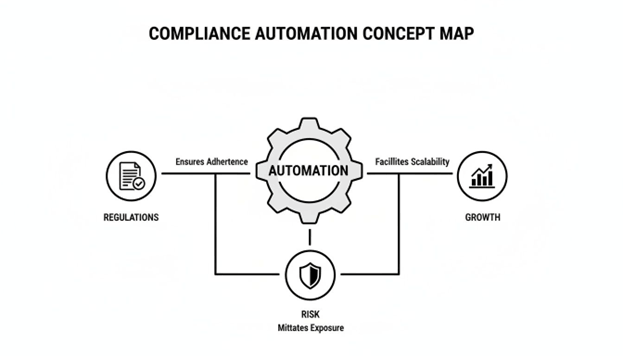
The key takeaway here is that automation isn't just a tech function. It’s the central gear that lets a financial institution manage regulatory burdens, protect itself from compliance headaches, and scale its operations all at the same time.
The real power kicks in when you connect the platform to your data. A modern system is built with an API-first mindset, meaning it's designed to talk to other systems. Instead of forcing you to upload messy spreadsheets, it builds a secure bridge directly to your core systems—your CRM, databases, or other applications of record.
For your technical teams, this is a game-changer. It means you can use a familiar REST API to send structured data like JSON or XML and just let the platform handle the document creation. This direct integration completely gets rid of risky manual data entry. You’re not just cutting down on typos; you’re creating a verifiable, end-to-end data flow that auditors can actually trust. The data in your final document is a perfect mirror of the data in your source system. Period.
Financial documents are never one-size-fits-all. A loan agreement in New York has different clauses than one in California. This is where conditional logic comes into play. A powerful automation engine lets you build these "if/then" rules directly into your templates.
Think of it like a "choose your own adventure" for documents. The system reads a data point—like a customer's state or the product they’re buying—and automatically includes or excludes the right legal text, disclosures, and branding.
This is what allows you to manage multi-jurisdictional compliance without getting lost in a nightmare of hundreds of slightly different template files. The system intelligently assembles the perfect, compliant document every single time based on the data it's given.
Beyond just one document, these platforms are built for heavy-duty work. The features that really separate an enterprise solution from a basic tool are:
These components—centralized templates, API-driven data, conditional logic, and scalable generation—are the building blocks of true automation. They take the process from a fragmented, manual mess and turn it into a controlled and auditable workflow. To see what this looks like at scale, you can get a deeper look at enterprise document automation and its moving parts. This is the blueprint for a system designed to meet the tough demands of modern finance.
Theory is one thing, but seeing financial compliance document automation in action is what really drives the point home. Let's step away from the abstract benefits and look at how this technology completely changes the day-to-day for financial services teams. The difference is night and day—moving from risky, manual work to a clean, fully auditable process.

It’s surprising how many finance teams are still stuck in a halfway-automated world. A recent survey of 450 finance leaders found that 54.2% of their teams are cobbling together inconsistent tools and a whole lot of manual effort.
But for those who go all-in? The results are huge. They report cutting processing times by 50% to 70% and literally slicing the cost per document in half.
Think about a loan officer at a regional bank. Before automation, putting together a single loan package was a painstaking, multi-hour affair. They’d have to manually pull customer details from the CRM, copy-paste that info into a dozen different Word templates, and then cross-check state-specific disclosure rules from some dusty PDF guide. All the while, just praying they didn't make a typo.
Now, with a platform like EDocGen, that whole process is flipped on its head:
1. One Click to Start: The officer just clicks "Generate Loan Package" right inside their CRM.
2. Instant Data: The system’s API immediately grabs all the necessary data—borrower info, loan terms, property details—from the bank's core systems.
3. Smart Assembly: Conditional logic built right into the master template automatically pulls in the right clauses and disclosures based on the borrower's state.
4. Done in Seconds: A fully compliant, 100-page loan package is generated as a perfect PDF and shot over to an e-signature platform.
What used to eat up half a day is now done in less than a minute. The risk of human error is virtually gone, and every action creates a perfect audit trail, showing exactly which data was used to build the document.
Now, picture an investment bank. They need to send out thousands of annual disclosure documents, and each one has to be personalized with that client’s specific portfolio data while meeting the latest regulations. Doing that by hand isn't just slow—it's impossible.
This is where bulk generation becomes a game-changer. Your IT team can send a single API call containing a JSON array with the data for thousands of clients. The automation engine takes over, churning through the data to produce a unique, personalized, and compliant disclosure for every single person on the list.
This isn’t just about speed. It makes a level of personalization possible that was just a fantasy before.
Instead of a generic, one-size-fits-all document, each client receives a report that feels tailored to them. This not only meets compliance requirements but also improves the client experience.
Here are a few other powerful examples of this in action:
These real-world scenarios show that a strong platform does a lot more than just fill in blanks. If you want a closer look at what this technology can build, you can check out a variety of document examples on our site.
With a robust API and flexible template logic, EDocGen provides the engine to solve these complex challenges, turning high-risk, manual processes into fast, accurate, and completely auditable workflows.
Picking the right platform is easily the most important decision you'll make. Plenty of tools can do a basic mail merge, but true enterprise-grade financial compliance demands a far more powerful and flexible engine. When you're looking at vendors, your checklist needs to be focused on what actually matters for finance and IT. You'll find that most generic platforms buckle under the pressure of strict security, data sovereignty, and the complex integration needs of the financial world.
This is precisely where EDocGen shines. It was built from the ground up for technical teams like yours in regulated industries. While many other solutions push a cloud-only, one-size-fits-all model, EDocGen gives you the control and flexibility that enterprises depend on.
For a technical decision-maker like you, this isn't just about a list of features; it's about control. A truly superior platform lets you integrate it cleanly into your existing tech stack and gives you complete sovereignty over your data. It doesn't force you into a rigid, external ecosystem.
The right partner makes life easier for your developers while also giving business users the tools they need. That dual capability is the signature of a solution that's truly ready for the big leagues.
When you start vetting potential platforms, a detailed checklist is your best friend. It helps you slice through the marketing noise and concentrate on the criteria that guarantee a successful, long-term partnership. The table below lays out the non-negotiable features you should be looking for and shows how EDocGen is engineered to meet these tough requirements, setting it apart from more basic alternatives.
|
Evaluation Criteria |
Why It's Critical for Compliance |
The EDocGen Advantage |
|
Flexible REST API |
A solid API lets you hook the platform into your existing systems (CRMs, databases), killing manual data entry—a huge source of compliance risk. |
EDocGen's API is built for developers. It can consume any structured data (JSON/XML) and fits right into your current workflows without forcing you to re-architect anything. |
|
On-Premise Deployment |
This is a must-have for financial firms that need 100% data sovereignty and control to satisfy regulators and internal security policies. |
Unlike many cloud-only vendors, EDocGen offers a solid on-premise option. This puts you in total control of your sensitive data, safe behind your own firewall. |
|
Complex Logic Support |
Financial documents are packed with dynamic content that changes based on jurisdiction, product, or client. The platform must handle complex "if/then" rules without needing custom code for every variation. |
Our no-code template designer lets business users build and manage intricate conditional logic themselves. This frees up your expensive developer talent from tedious template work. |
|
Enterprise Security |
Protecting client data is absolutely non-negotiable. You need strong encryption for data in transit and at rest, plus meticulous audit trails for every action. |
EDocGen gives you AES-256 encryption and creates unchangeable logs for every document event, delivering the rock-solid auditability that regulators demand. |
|
Proven Scalability |
The system has to be able to crank out huge volumes of documents in bulk—think thousands of client statements at once—without slowing to a crawl. |
EDocGen is built to scale. It can effortlessly manage the massive batch runs required for things like periodic reporting and mass client mailings. |
This checklist should give you a clear framework for making a decision that not only solves today's problems but also scales with you for years to come.
The real power of EDocGen comes from its developer-first design. Our REST API is the ultimate integration tool. It’s built to consume any structured data you give it— JSON or XML —so your dev team can hook it directly into your existing systems of record without a fuss. No re-architecting your entire stack, no fighting with proprietary connectors.
But we also know your developers' time is your most precious asset. That’s why we paired that powerful API with a no-code template designer. This simple move lets your business users own the creation and management of even the most complex document logic.
Think of it this way: your developers build the secure data highway, and your business teams design the cars that drive on it. This splits the workload perfectly, freeing up your engineers from endless template tweaks so they can focus on high-impact work.
This dual-capability is where most other platforms fall short. They're either too locked down for developers or far too basic for complex business rules. EDocGen delivers both: deep technical flexibility and true business user empowerment.
In finance, data sovereignty isn’t a preference; it’s a hard requirement. Many vendors will try to sell you a cloud-only solution, but that’s a non-starter for institutions that have to keep sensitive client data behind their own firewalls. A generic cloud platform just can't provide the control that regulators and your own security policies demand.
EDocGen tackles this head-on by offering a full on-premise deployment . This gives you the final word on security and guarantees 100% data sovereignty . All your data—from the moment it's generated to the moment it's stored—stays inside your own secure infrastructure. For a technical leader like you, responsible for guarding the firm’s most critical assets, this is the only real answer.
When you put that level of security together with a flexible API and a business-friendly interface, the choice becomes clear. EDocGen isn't just another document tool. It’s the secure, adaptable engine built from the ground up to handle the mission-critical demands of enterprise compliance.
This is a huge one. Nobody wants to manage hundreds of document templates just to stay compliant across different jurisdictions.
A strong platform like EDocGen uses conditional logic to solve this. You build one master template that intelligently adds or removes specific clauses, disclosures, or entire sections based on a data point, like a customer's country code. This means every single document is automatically tailored to its specific jurisdiction, cutting down on maintenance and dramatically reducing risk.
With a modern REST API, the technical work is something your developers have seen a thousand times. EDocGen is built from the ground up to plug into your existing systems of record, whether that’s a CRM, a core banking platform, or a simple database.
The main job is mapping your data sources to the document templates. But since our no-code designer lets your business teams handle the document logic themselves, your IT resources can stick to what they do best—the core integration. This is how pilot projects get off the ground in weeks, not months.
Security isn't an afterthought; it has to be the foundation. The best solutions come with multiple layers of protection, including AES-256 encryption for all your data, both when it's moving and when it's sitting on a server.
For institutions that need total control, EDocGen offers an on-premise deployment. This keeps every piece of data behind your own firewall. For many financial firms, this level of data sovereignty is non-negotiable and a major difference from cloud-only tools.
Just as important, every single time a document is generated, the event is logged. This creates a permanent, unchangeable audit trail. You can prove exactly who generated what document, when they did it, and the precise data used. Audits transform from a frantic search for proof into a simple reporting task.
Ready to see how a truly flexible and secure engine can transform your compliance workflows? Discover why EDocGen is the enterprise choice for financial compliance document automation by visiting https://www.edocgen.com .