
For banks, document automation is the key to faster loan approvals. It works by taking all the slow, mistake-prone manual steps—like data entry and building loan packages—and replacing them with a fast, digital workflow. The end result? Software that can instantly create accurate, compliant loan documents , cutting a process that takes days down to just a few hours.
Before getting into the nuts and bolts of the technology, let’s talk about the very real problem it solves. This isn't just about a slow back-office process; it’s about the stress and frustration it causes for both your customers and your employees.
Let’s look at a classic scenario. Sarah, a small business owner, just landed a huge contract but needs a loan for new equipment to get the job done. Every single day she has to wait for loan approval is another day she’s at risk of losing that contract. She calls, she emails, but the answer is always the same—a delay, a missing form, an internal holdup.
On the other side of the desk is Mark, your loan officer. He’s not trying to be slow. He’s just buried. His world is a mess of PDFs, scanned driver's licenses, and never-ending email threads. A huge chunk of his day is spent just copying and pasting information from one system to another, chasing down signatures, and double-checking that he’s using the most recent version of the loan agreement.
In a manual process like this, the friction is palpable. A single typo can bring everything to a grinding halt. Using an outdated form isn't just an inconvenience; it's a massive compliance risk that could even void the entire loan.
Traditionally, the sheer amount of paperwork and verification steps for every single application was overwhelming.
To give you a clearer picture, let's compare the old way with the new.
This table breaks down how much time and effort goes into each stage of the loan document process, showing the stark difference between a manual and an automated workflow.
|
Process Step |
Manual Workflow (Time/Effort) |
Automated Workflow (Time/Effort) |
|
Data Collection |
2-4 hours. Manual entry from various sources (PDFs, emails). |
5-10 minutes. Data is pulled automatically from integrated systems. |
|
Document Generation |
1-3 hours. Manually assembling Word docs, copying/pasting data. |
Under 1 minute. System generates the complete document package instantly. |
|
Internal Review |
1-2 days. Back-and-forth emails, checking for errors and compliance. |
30-60 minutes. Automated rules flag issues; review is focused on exceptions. |
|
Signature & Closing |
2-5 days. Printing, mailing, waiting for physical signatures. |
1-2 hours. E-signatures are requested and returned in minutes. |
|
Final Filing |
1-2 hours. Manually scanning signed copies, uploading to different systems. |
Instant. Signed documents are automatically filed and archived. |
The difference is night and day. What used to be a week-long paper chase becomes a highly efficient, predictable, and mostly hands-off process.
This manual bottleneck doesn’t just slow things down; it creates a cascade of problems that affect everyone involved:
This is precisely the environment document automation was built to fix. Moving from paper and email to an automated digital workflow has already shrunk application-to-decision times from 5-10 business days down to 24-48 hours for many standard loans. It’s a fundamental change that replaces anxiety and inefficiency with speed, accuracy, and a much better experience for everyone.
So, how do you actually use document automation to get loan approvals out the door faster? Let's move past the 'why' and dig into the 'how.' The best way to picture it is as a digital assembly line for your loan documents, handling everything from the first piece of data to the final e-signature.
This isn't some black-box magic; it's a well-engineered workflow. For anyone with a technical or semi-technical background, the idea is simple: you’re running a system on centralized templates and smart data mapping. Let’s follow a single loan application as it moves through this automated process.
The whole thing kicks off the second a potential borrower hits "submit" on an online loan application.
With an automated workflow, that first step is completely seamless. The information from the online form—the applicant's name, business revenue, loan amount—is captured as structured data, usually in a format like JSON or XML. The document automation engine grabs this information instantly. There is no manual data entry , which kills the biggest source of human error right from the get-go.
This initial data capture is the bedrock of the entire automated process. When you treat the application as a data source instead of a static document, you set the stage for generating perfect documents instantly.
Once the data is in, the document automation platform starts its real work. This is where a system like EDocGen becomes the engine for your assembly line. It doesn’t just fill in a few blanks on a form; it builds a complete, multi-part loan package in a matter of seconds.
Here’s a look under the hood:
Modern lending is a minefield of rules that shift based on the loan type, amount, state, and borrower. An automated system navigates this complexity effortlessly using conditional logic .
Think of it as a set of "if-then" rules baked right into your templates.
This is a massive win for compliance. It guarantees that every loan package is built with the correct, up-to-date legal clauses for that specific situation. The risk of a loan officer forgetting a critical addendum or grabbing an outdated form from their desktop vanishes completely. If you want to dive deeper into the nuts and bolts, you can learn more about how to design an effective approval document workflow that uses these principles.
This kind of intelligent assembly is what makes a true enterprise platform like EDocGen different from basic mail-merge tools. You're not stuck with rigid, one-size-fits-all templates. The platform’s ability to handle complex, nested logic means it can generate sophisticated documents that match the real-world twists and turns of lending. From here, the finished package is sent for internal review and then on to the customer for an e-signature, closing the loop on a fully digital journey.
A standalone document automation platform is a good start, but its real magic is unleashed when it’s connected to the other systems your bank runs on. This integration is the technical heart of the solution, turning a simple document generator into the central nervous system for your bank's loan data.
For you tech-savvy folks, understanding this backbone is crucial. It’s how document automation delivers such dramatic speed and efficiency gains in loan approvals.
At its core, the platform acts as a central hub. It uses a powerful REST API to talk with your existing tech stack, creating a smooth, two-way street for information. This is what finally ends the soul-crushing, error-prone cycle of copy-pasting data between different apps—a task that eats up countless hours for loan officers like Mark.
Imagine a world where your loan data flows automatically and precisely where it's needed, with zero human meddling. That’s what a well-integrated system delivers.
This simple flow chart breaks down the automated journey from data to signature.
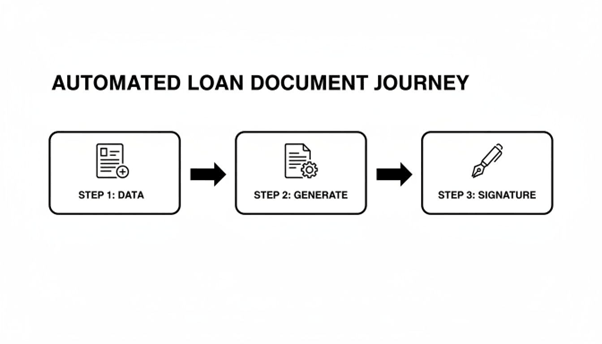
What was once a tangled web of manual tasks becomes a clean, straightforward, and fully automated process.
Not all integrations are built the same. Many generic tools offer flimsy, pre-built connectors that just can't handle the unique demands of banking. This is where the platform’s design gives your technical teams a serious leg up.
An API-first design means the platform was built from the ground up to be connected. It's not an afterthought. This ensures maximum flexibility when linking to both modern, cloud-based apps and the legacy, on-premise systems so common in the financial world.
Instead of being boxed in by rigid, one-size-fits-all connectors, your IT and integration specialists get a powerful and well-documented REST API . This gives them the freedom to build custom, rock-solid connections that fit your bank’s unique setup like a glove.
Whether you're pulling complex data from an old mainframe or getting real-time updates from a new CRM, a flexible API ensures the information flows reliably.
This approach empowers your technical teams to solve real business problems, not fight with their tools. For your loan officer, Mark, the difference is night and day. He no longer juggles five different applications. He works in one, and the data follows him, creating a single source of truth that speeds up every single loan he touches.
Getting your head around document automation is one thing. But when you’re a decision-maker in the high-stakes world of banking, the real question is always: which tool will actually deliver the results, security, and long-term value we need? Plenty of platforms slap an "automation" label on their product, but EDocGen was engineered from the ground up to handle the specific, thorny challenges of your industry.
Picking a solution isn't about ticking off features on a checklist; it's about finding a partner that gets the nuances of lending. The choice usually boils down to a generic, one-size-fits-all tool, a risky and expensive in-house build, or a platform that’s truly specialized. We believe EDocGen is the clear winner for banks, and it all comes down to three things: superior data flexibility, business user empowerment, and rock-solid security.
Let's be honest: basic document tools just can't keep up with modern lending. They’re fine for simple mail merges, but they fall apart when you throw complex data and conditional rules at them. For a bank, where a single loan package can have dozens of variables, that’s a complete non-starter.
Its real strength is its ability to natively process nested data from JSON and XML —the languages spoken by your core banking applications and modern APIs.
Think of it like this: a basic tool can read a simple shopping list. The system can read a complex recipe with nested instructions, sub-recipes, and steps that change based on what’s in your pantry. It’s light-years beyond the rigid, template-locked approach of generic tools that can't handle complex data structures.
This technical edge has a massive real-world impact. It means the platform can easily handle:
This kind of flexibility means you never have to dumb down your loan products to fit the limitations of your software. Instead, the software adapts to your business—no matter how complex.
In most banks, even a tiny change to a document template—like updating a legal disclosure—turns into a whole ordeal. It means an IT ticket, weeks of waiting, and pulling a developer off a more important project. This creates a huge bottleneck that slows down new product launches and makes it impossible to react quickly to market changes.
The platform completely flips this model on its head by putting the power in the hands of the people who know the documents best: your business users. Our intuitive, no-code template designer lets loan operations teams, compliance officers, and product managers take the reins.
Without writing a single line of code, your teams can:
This self-service approach dramatically reduces the dependency on your IT department for day-to-day document tasks. IT's role transforms from gatekeeper to strategic partner, focusing on high-value integrations while the business teams manage the content. It’s a game-changer for getting new financial products to market faster. To see how this transforms banking operations, check out our guide on banking and financial services automation .
For any financial institution, security and data control are non-negotiable. Period. Public cloud solutions that process sensitive customer data on shared infrastructure introduce a level of risk that is simply unacceptable. The platform was designed with a bank's security posture in mind from day one.
The most critical difference is our flexible deployment model. The system can be deployed on-premise or within your own private cloud , giving your organization complete control and sovereignty over your data. This single feature eliminates the risks tied to multi-tenant cloud environments and is a deal-breaker for many institutions.
On top of that, the platform is packed with features essential for a regulated industry:
In the race to speed up loan approvals, there's a question that always comes up: how do you move faster without cutting corners on compliance? For any bank, speed is useless if it invites risk. This is where document automation becomes more than just an efficiency play—it's a critical defense for your Governance, Risk, and Compliance (GRC) teams.

Think of it this way: document automation doesn’t just make the process faster; it builds in guardrails that guarantee you stay on the approved path. For your GRC professionals, this delivers a level of control and insight that manual workflows could never offer.
One of the biggest compliance headaches in banking is the "rogue document." This is what happens when a loan officer, with the best intentions, uses an old loan agreement they saved on their desktop—one that’s missing a brand-new regulatory clause. That single mistake can open the door to serious legal and financial trouble.
Document automation stops this problem at the source by using centralized, version-controlled templates .
This tight, centralized control is fundamental to how banks use document automation to get loans out the door faster while making their compliance posture stronger.
When auditors show up, their first question is always the same: "Can you prove it?" A manual, paper-based process turns this into a nightmare. You’re left scrambling through email threads and scanned files, trying to stitch together what happened.
An automated system, on the other hand, creates a perfect, digital breadcrumb trail for every single document.
Every action—from generation to review to e-signature—is automatically logged with a user ID and a precise timestamp. This creates an immutable, court-admissible audit trail that can be produced in minutes, turning a stressful, week-long audit scramble into a simple report pull.
This built-in record-keeping gives you undeniable proof of compliance. It clearly shows who did what, when they did it, and the exact document version they used. In fact, research shows that manual compliance processes lead to seven times more examiner concerns than automated ones. While banks stuck with spreadsheets and email are exposed, those with integrated automation see these regulatory headaches drop significantly.
Beyond simple efficiency, the smart use of AI, even as seen with AI automation for small business, is key to strengthening compliance and managing risk in banking. Modern platforms give you the tools not just to speed up lending but to build a more resilient and defensible operation. For more strategies on this, our guide on automating banking and financial documents offers some great perspectives. The message for your GRC teams is clear: solid document automation is one of the most effective risk management tools you can have.
Can Document Automation Handle Our Complex Excel Files Used for Underwriting?
Yes, and this is a critical differentiator. This is a huge sticking point for many banks, and it’s something the platform is built to solve. Most generic automation tools simply can't handle unstructured or semi-structured data; they choke on the complex Excel files your underwriting team relies on.
Many tools force you to perfectly reformat your data before they can use it. The platform uses AI to intelligently read and understand these complex spreadsheets, which is a massive relief for your team.
This feature alone removes a major bottleneck. It means you stop wasting time on manual data entry and reformatting, and let the system do that heavy lifting for you. Other platforms simply can’t match this capability.
How Difficult Is Implementation and Integration with Our Core Banking System and CRM?
This is always a top concern, especially for institutions with established, legacy systems. The system was designed for this reality. We use a well-documented REST API that makes the whole process much simpler and more predictable than alternatives. Implementation isn't a massive, disruptive project; it's a focused, collaborative effort.
Here’s the typical flow:
Unlike big, monolithic systems that require a total teardown and rebuild, The platform's API-first design lets you roll it out in stages. This approach gets you quick wins, reduces disruption, and allows your teams to see the benefits of automation right away.
This parallel approach—technical integration and business configuration happening at the same time—slashes implementation timelines. If you want to dig deeper into the basics, our guide on what document generation is is a great place to start.
How Does Document Automation Protect Sensitive Customer Loan Data?
Security isn't an afterthought; it's the foundation. An enterprise-grade platform is built for security from the ground up. Generic, multi-tenant cloud tools can introduce risks that are simply not acceptable for financial data, but the platform gives you multiple layers of serious protection that are superior to other options.
The first, and most important, is data sovereignty . The system can be deployed on-premise or in your own private cloud . This means your bank retains complete control over where sensitive customer loan data is stored—a non-negotiable for most financial institutions and a feature not offered by many competitors.
Beyond where the data lives, the platform is hardened with essential security features:
This layered security model is far more robust than emailing PDFs around or saving files on shared network drives. It replaces a scattered, risky process with a centralized, hardened, and fully auditable system.
Ready to see how a truly flexible and secure platform can transform your lending operations? Discover what EDocGen can do for your bank and move beyond the limitations of generic tools. https://www.edocgen.com