
Contract automation in banking isn't just a buzzword; it's the specific use of software to build, manage, and execute financial agreements without the usual manual grind. As a technical or semi-technical leader, you know the pain of disconnected systems. This software works by replacing those error-prone human tasks with automated workflows , pulling data straight from your core systems to generate fully compliant documents. Think faster loan originations and smoother customer onboarding, all while reducing the burden on your team.
Picture the familiar chaos before a big loan closing. Your loan officers are buried in paperwork, frantically double-checking data between the CRM and the core banking system. The compliance team is chasing down signatures, hoping a single typo on page 87 won’t trigger a massive regulatory fine. All the while, you and your IT team are trying to wrangle insecure document versions being passed around in emails.

Now, imagine the alternative. A loan officer clicks a button inside their CRM or Loan Origination System (LOS). Within minutes, a complex, personalized, and fully compliant loan packet is generated and ready for review. This is the new standard that contract automation for financial institutions makes possible.
This isn't just about making PDFs faster. It's a fundamental change in how your documents are architected and handled. Data flows securely from its single source of truth—like your CRM or core banking platform—directly into the final, e-signed agreement, all within one auditable system.
This jump from manual chaos to automated control gives you a real competitive edge by tackling your biggest operational headaches. As you can see in our guide to banking and financial document automation , the benefits go far beyond just saving time.
Modern contract automation is built to fix the specific, high-risk challenges you face in financial services. It lets you move from a state of constant vulnerability to one of control and confidence.
Here are the key problems it solves:
As someone with technical expertise, you know that not all automation tools are built the same. When it comes to the financial sector, a generic, off-the-shelf document tool just can't keep up with the intense regulatory and operational demands you face daily.
These one-size-fits-all platforms inevitably stumble when they meet the non-negotiable rules of banking, insurance, and investments. They simply weren't designed for the unique pressures of your industry, creating huge risks that a purpose-built solution like EDocGen is designed to prevent from the start.
Think about a typical financial agreement—it's rarely a simple fill-in-the-blanks exercise. A syndicated loan, a custom wealth management contract, or a multi-layered insurance policy all depend on complex conditional logic. For instance, a loan agreement might need entirely different clauses based on the borrower’s state, their credit score, the loan-to-value ratio, and the specific product they chose.
A generic tool usually tops out at basic "if/then" logic, which falls apart when faced with this kind of complexity. It can't manage nested conditions, dynamic tables for amortization schedules, or compliance rules that have to change on the fly across different jurisdictions. This inevitably pushes your teams back into risky manual workarounds, completely defeating the purpose of automation.
A purpose-built platform understands that a financial document is not just a template to be filled. It's a dynamic assembly of data-driven components, each governed by its own set of business and regulatory rules.
This is exactly where a platform like EDocGen shines. Unlike the alternatives, it was engineered from the ground up to handle deeply nested conditional logic and complex data, allowing it to piece together sophisticated documents with pinpoint accuracy, every single time. This is a core architectural difference, not just a feature.
In finance, data isn't just information—it's a massive liability. Ironclad data governance isn't a "nice-to-have"; it’s a direct regulatory mandate. Right away, many generic, cloud-only tools create a serious problem with data residency. Your institution is likely required to keep customer data within specific geographic borders or even completely behind your own firewalls.
This is a dealbreaker for tools that don't offer on-premise or private cloud deployment—something EDocGen provides. Beyond that, these generic tools frequently lack the granular access controls and complete audit trails that regulators demand. They might not offer the robust AES-256 encryption for data at rest and in transit that is the absolute standard for any financial-grade system.
Here’s where generic security models just don't make the cut:
A contract automation platform is only as valuable as its ability to communicate with the rest of your tech stack. In finance, this means deep, bulletproof integrations with core banking systems, CRMs like Salesforce, and Loan Origination Systems (LOS). A generic tool usually offers flimsy connectors or a basic API that can't process the complex data payloads, like nested JSON or XML, that are standard in finance.
This is why EDocGen's API-first architecture is such a critical differentiator. It isn't just a buzzword; it's our fundamental design philosophy that ensures the platform can be seamlessly woven into any existing workflow you've built.
Think about the technical demands:
Platforms like EDocGen are built with this API-first mindset. They aren’t just standalone tools; they're designed to be integral components of a larger enterprise architecture, ensuring they can de-risk your automation strategy and scale right alongside your institution. Getting this choice right from the start is crucial, and you can learn more by exploring some of the best document generation software on the market.
Alright, let's move from the high-level theory to what this actually looks like on the ground. When we talk about contract automation for financial institutions , we're not just talking about minor tweaks. This is about a complete overhaul of your core workflows, trading in sluggish manual tasks for speed, precision, and a whole new level of agility.
We’ll look at the "before" and "after" picture for critical jobs like processing loans and onboarding new customers.
The difference is night and day. Top-performing banks and financial firms that have embraced these tools are seeing KYC and loan processing times get slashed by an incredible 60-70% . It’s not just about speed, either—they’re also seeing operational costs fall by over 45% , all while getting data entry errors down to practically zero.
Think about it this way: even a modest 15% bump in automation can reduce compliance costs by 10% . For credit unions and medium-sized banks watching their budgets, that's a massive win. This all happens by swapping out those high-friction, manual steps for smart, repeatable processes that completely change the game.
The old way of originating a loan is a well-known bottleneck. A loan officer is stuck for hours manually pulling documents together, copying and pasting customer data from the CRM, and double-checking every detail against the core banking system. The "before" is a mess of delays, version-control nightmares, and a constant risk of human error.
Now, picture the "after." With automation, that same loan officer can kick off the entire process with a single click inside their Loan Origination System (LOS). From there, the system just takes over. It automatically:
Getting the details right on specific documents, like mastering the loan contract format, is a huge part of this. Automating these intricacies is what really helps shrink the time-to-close.
Bringing new clients on board, especially in wealth management or corporate banking, is another area bogged down by manual work. The Know Your Customer (KYC) and Anti-Money Laundering (AML) checks mean collecting, verifying, and filing a mountain of information. The "before" is a slow, paper-driven headache that makes for a terrible first impression and puts a drag on revenue.
Automation transforms onboarding from a compliance chore into a competitive advantage. It ensures that your first interaction with a new client is fast, seamless, and professional, setting a positive tone for the entire relationship.
Here’s how automation completely flips the script on onboarding:
Maybe the biggest change of all is who's in the driver's seat. In the past, any little change to a document template—even fixing a typo—meant filing a ticket with the IT department. This created a huge bottleneck that could slow down everything from product launches to critical compliance updates.
This is where a solution like EDocGen really changes things. Its powerful, no-code template designer gives the keys to the business users themselves—the loan officers, compliance managers, and product teams. They can build complex logic, add conditional sections for different scenarios, and manage versions in multiple languages, all without ever writing a line of code.
This kind of self-service takes a massive load off your IT team, freeing them up to focus on big-picture strategy instead of tiny template edits. When you put control in the hands of the subject-matter experts, the whole organization becomes nimbler and more responsive. It proves that automation is way more than just a cost-cutting play; it’s what makes your business truly agile.
To see more, you can check out the specific benefits of our purpose-built banking automation solutions .
For any technical lead, the real question isn't if a new platform works, but how it plugs into everything else. A standalone tool is a dead end. Contract automation in finance only starts paying off when it becomes a seamless part of your core systems—your digital nervous system.
This is where a platform’s architecture becomes the make-or-break factor. An API-first solution isn't just another application; it's a service designed to be woven into your existing workflows. It’s built with the expectation that it needs to talk to your core banking system, CRM, and Loan Origination System (LOS), giving you a clear and secure blueprint for integration.
The process below shows how data moves from origination through onboarding and reporting in a system that’s truly connected.
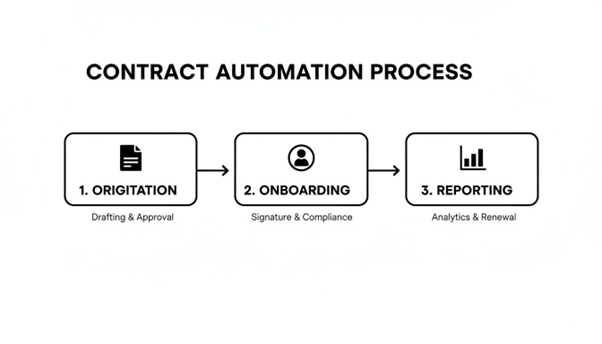
This isn’t just one action. It's a connected chain of events that keeps your data clean and consistent from the first step to the last.
Connecting to your established tech stack is the first hurdle. Let's look at the proven ways to integrate with the most common platforms in finance.
IT leaders need to know a platform was built for their world, not a generic one. Strong API documentation and a track record in these complex environments provide that confidence.
The real goal of integration isn't just to connect two boxes. It's to create an automated, event-driven workflow where the platform reacts to business events in real-time, making document generation an invisible and instant part of the process.
Your integration strategy has to cover different operational needs. The choice between real-time API calls and batch processing comes down to the specific use case.
Real-Time Generation (via REST API): This is non-negotiable for on-demand, customer-facing interactions. When an advisor needs to generate a personalized investment proposal during a meeting, a real-time API call is the only way. It delivers instant results and keeps the business moving.
Batch Processing: This pattern is perfect for high-volume, less urgent jobs. Think of generating thousands of monthly account statements, annual tax forms, or compliance notifications. Here, a system can schedule a job to run overnight, feeding a massive dataset to the API to produce documents in bulk. It's a far more efficient use of system resources.
A good platform is engineered to handle both, giving you the flexibility to build the right workflow for the job.
For any financial institution, security isn't just a feature; it's the entire foundation. A viable integration plan has to address security from day one.
Here’s how a purpose-built platform handles these non-negotiables:
By combining a powerful, well-documented API with a security-first architecture, you get the robust integration capabilities that technical teams demand.
EDocGen was designed from the ground up to give you the security and power of a true enterprise system, but with the flexibility your business teams actually need to get their work done. This isn't just about tacking on a few finance-related features; our entire platform is engineered to solve the industry's toughest document challenges where others fail.
Ask anyone in finance about their biggest data headaches, and you'll probably hear about Excel. Investment schedules, commission statements, property portfolios—all this critical data lives in spreadsheets that are often a mess of merged cells, multiple tabs, and inconsistent formats.
Most automation tools choke on this kind of unstructured data. They demand perfectly formatted JSON or XML, or they just give up, forcing you into manual data cleansing. EDocGen solves this with AI-powered data extraction . Our system is smart enough to read those complicated Excel files, figure out what data goes where, and populate it into your templates correctly. This alone fixes a massive operational bottleneck that most other platforms won't even touch.
The push for this kind of intelligent contract automation in financial institutions is getting stronger every day. The market for AI in banking is set to jump from $38.36 billion in 2024 to a staggering $190.33 billion by 2030, all driven by the need to be more efficient. For example, real estate firms using our AI to pull data from messy spreadsheets can automate lease agreements and slash manual work by up to 39% .
One of the biggest things that slows down banks and financial firms is the dependency on IT for every little template change. EDocGen completely flips that around. We put a powerful, no-code template designer directly into the hands of your business users—the people who actually know the contracts inside and out.
This is more than just dragging and dropping a few fields. Without writing any code, your teams can build truly sophisticated documents.
But giving business users this power doesn't mean sacrificing control. IT still has complete governance over the platform. You decide which templates are approved and published, ensuring everything stays compliant. It’s the perfect balance: business teams move quickly, and IT knows the platform is secure and governed. This is a core advantage you won’t find in simpler tools.
Many modern software platforms are cloud-only, forcing you to send your sensitive data to a shared environment. That's a non-starter for most financial institutions. EDocGen was built with your security and compliance needs first, offering a flexible architecture that adapts to your policies, not the other way around.
For financial institutions, security isn't a feature—it's a foundational requirement. A platform must adapt to your security posture, not the other way around.
You get to choose the deployment model that makes your security and compliance teams happy:
This flexibility, combined with AES-256 encryption and detailed audit trails, makes EDocGen a solution that even the most risk-averse organizations can trust. You don't have to choose between modern features and rock-solid security. To see how this works in practice, you can learn more about our approach to enterprise document automation .
How Does Automation Integrate With Our Core Banking System and CRM?
This is probably the most important technical question, and the short answer is: through an API-first design. A platform like EDocGen is built to be a natural extension of your tech stack, not another isolated tool that creates more work for your team.
For modern CRMs like Salesforce, this often means you get pre-built connectors that are practically plug-and-play. Your team can generate documents right from an opportunity or account record without leaving the screen. For core banking systems or older, custom-built platforms, our powerful REST API is the universal bridge. Your IT team can trigger document generation from any application just by making a secure API call.
Think about it this way: when a loan is marked "Approved" in your Loan Origination System (LOS), it can automatically ping the EDocGen API. The API call passes over the necessary data (like the loan amount, borrower's name, and terms) as a JSON payload. EDocGen then instantly assembles the fully compliant loan packet and can even push the final document right back into the LOS. You get a completely hands-off, end-to-end workflow with a perfect audit trail for the regulators.
What Really Differentiates EDocGen From Other Tools?
It all comes down to flexibility, power, and focus. A lot of document tools out there are really just glorified mail-merge functions. They're great for simple letters but fall apart when you hand them a complex financial agreement with nested logic, dynamic amortization schedules, or rules for different jurisdictions.
On the other end, you have massive, one-size-fits-all platforms that cost a fortune and require a team of developers for even the smallest change. EDocGen occupies a superior middle ground. It gives your business users a powerful, no-code template designer while providing your tech teams with an enterprise-ready, API-first engine.
The real advantage is merging business agility with IT control. Business users can build and manage complex templates without writing a line of code, while IT retains full governance over security, integrations, and deployment.
This unique approach is what allows EDocGen to handle complex data structures (like messy spreadsheets), offer robust multi-language support, and provide flexible on-premise deployment to meet strict data residency rules—a deal-breaker that many cloud-only tools just can't handle.
How Can We Ensure Compliance and Security?
A platform designed for finance tackles this with several layers of protection. First up is template governance . This ensures that only approved, compliant language is used across the entire organization. You have central control over every published version, so you can stop rogue clauses or outdated terms in their tracks.
Second, data security is handled through AES-256 encryption for all documents, both when they're sitting on a server and when they're being sent. Just as important, our flexible deployment options let your institution keep all sensitive customer data safely behind your own firewall, unlike rigid SaaS-only providers.
Third, every single document generated and every action a user takes is logged. This creates an unchangeable audit trail that makes regulatory reporting straightforward. The system's internal logic automatically pulls in the right legal clauses based on the product and jurisdiction, which systematically reduces human error and ensures compliance is built-in, not bolted-on.
Ready to see how a document generation platform built for the complexities of finance can truly change your operations? Explore EDocGen to learn how our flexible, secure, and powerful solution helps financial institutions automate contracts, slash risk, and grow faster. Learn more at https://www.edocgen.com .