
Manual regulatory filing work fails in predictable places. Data gets copied from multiple systems. Calculations are rechecked under time pressure. Reviewers spend more time proving which version is correct than reviewing the substance of the filing.
That is why automation has become operationally important, not optional.
When firms automate regulatory filing documents for finance, they are not merely speeding up document production. They are removing fragile handoffs, making data lineage visible, and reducing the number of places where a manual edit can become a filing problem. The practical benefit is control. The strategic benefit is that quarter-end stops feeling like an emergency.
Financial institutions moving from manual workflows to advanced automation systems have reduced reporting cycle times by up to 70% and cut compliance costs by 30-50% , according to McKinsey & Company and other industry analyses summarized here. Those gains matter because the pressure around filings is not just about labor. It is about reducing failure points in a process that regulators expect to be repeatable and defensible.
The first problem is fragmentation. Core figures often live in banking platforms, finance databases, CRMs, and spreadsheet workbooks maintained by different teams.
The second problem is timing. Many teams still assemble the final document in the last mile, a stage where formatting, tagging, versioning, and sign-off all collide.
The third problem is accountability. When a number changes late, teams often cannot immediately answer three basic questions: where the new value came from, who approved it, and whether every downstream report has been updated.
A working automation setup does four things:
· Pulls data from systems of record: Teams stop rekeying data that already exists elsewhere.
· Applies repeatable rules: Calculations, conditional sections, and validations run the same way every cycle.
· Controls review: Approvers review exceptions and judgment calls instead of rechecking every cell.
· Creates an audit trail: Every generated file can be traced back to source data, template logic, and approval steps.
That is the shift that matters most. Filing becomes a controlled workflow instead of a deadline-driven assembly exercise.
Teams often assume the hard part is the document itself. In practice, the hard part is the operating model around the document. Once you fix the data path, the template logic, and the approval chain, the filing process becomes much easier to run and easier to defend.
Most failed automation projects start too late in the process. The team picks a tool, builds a template, and only then discovers that half of the required data is manually assembled inside spreadsheets no one formally owns.
The better approach is to treat the first phase like a system mapping exercise. Before you automate output, you need a stable input model.

A successful automation methodology begins by integrating core banking systems and financial databases into a unified data layer.
Do not delegate discovery to IT alone. Regulatory filing automation sits at the intersection of finance operations, compliance interpretation, and enterprise data integration.
Get these groups in the room early:
· Finance operations: They know where the reporting bottlenecks are.
· Compliance and risk: They know which judgment points cannot be blindly automated.
· IT and integration teams: They know what can be pulled through APIs, databases, and existing pipelines.
· Document owners: They know how the filing is assembled, reviewed, and submitted.
This session should produce one concrete output. A filing inventory.
A useful filing inventory is not a policy memo. It is a working artifact.
Include at least these fields:
|
Item |
What to capture |
|
Filing name |
Exact report or submission type |
|
Jurisdiction |
Which regulator or reporting framework applies |
|
Source systems |
Database, CRM, ledger, Excel workbook, data warehouse |
|
Data owner |
Team or person responsible for the field |
|
Transformations |
Calculation rules, mappings, formatting logic |
|
Review points |
Who checks what before submission |
|
Submission method |
Portal upload, XML/XBRL output, email, archive |
|
Exception risk |
Which fields or sections are frequently disputed |
Hidden complexity often surfaces here. A “single report” often turns out to be a bundle of business rules, source dependencies, manual reconciliations, and informal approvals.
A common mistake is to start by recreating the final filing layout. That feels productive, but it locks in a bad process.
Map these in order:
1. Source data Pull required values from core systems first.
2. Transformation logic Define calculations, conditional rules, and field normalization.
3. Validation rules Decide what must be checked before any document is generated.
4. Output requirements Only then define the final filing format and supporting documents.
This sequence matters. If a figure is unstable upstream, no template can save you downstream.
Tip: If a team says, “we fix that in the final spreadsheet,” stop and document it. That is exactly the kind of manual repair point that breaks automation later.
Not every filing requirement is negotiable, but much of the process around it is.
Standardize:
· Field naming conventions
· Date and currency formatting
· Entity and jurisdiction codes
· Approval states
· Document naming and storage rules
Where teams need flexibility, give them controlled flexibility. That is where a document platform earns its keep. For example, financial document automation platforms are useful when they can connect to APIs, databases, CRMs, JSON, XML, and spreadsheets without forcing the business team into a custom development queue for every change.
What works is starting with one filing family that has clear ownership, reliable data, and repeatable cycles. What does not work is beginning with the messiest multi-jurisdiction process in the company because it looks strategically important.
What works is documenting transformation rules in plain language that finance and IT both understand. What does not work is burying business logic in scripts that only one developer can maintain.
What works is accepting that discovery will expose process debt. That is a feature, not a delay.
A template is not just a formatted document. In regulatory filing work, it is a controlled execution layer for business rules.
That distinction matters because many automation efforts stall here. Teams build what is a nicer mail merge. It fills placeholders, but it cannot handle jurisdiction-specific sections, transaction-level loops, conditional disclosures, or calculations that change when a classification changes upstream.
A hard-coded template looks fine at first. It is predictable. It can even be fast to launch.
Then the filing changes.
A section becomes conditional by jurisdiction. A table needs to expand dynamically based on transaction count. A reviewer asks for a rule that suppresses one clause and inserts another when a threshold or entity type changes. Suddenly a simple document becomes a maintenance project.
That is why no-code template logic matters. By using no-code tagging for conditional logic, loops, and calculations, automation can reduce manual effort in financial document creation by 70-90% , reduce error rates by 40% , and achieve 98% audit-ready documents according to this financial document automation overview .
A useful finance filing template should be able to do more than insert values.
It should support:
· Conditional sections: Include one disclosure for one jurisdiction and suppress it for another.
· Loops and nested tables: Generate repeating rows or grouped transaction disclosures without manual expansion.
· Calculated fields: Perform controlled calculations inside the template logic where appropriate.
· Multi-format output: Produce Word, PDF, or regulator-ready outputs from the same core template logic.
· Structured and semi-structured data inputs: Handle JSON, XML, spreadsheets, and system exports without requiring a full rebuild.
For teams managing variation across product lines or legal entities, grouping related layouts under shared logic is often more maintainable than cloning files endlessly. That is the practical value of features such as group templates , where common logic can be reused while still allowing controlled differences in output.
The strongest setup gives each team control over the part they understand best.
|
Team |
Best ownership area |
|
Business users |
Template wording, section logic, disclosure variations |
|
Compliance |
Validation rules, approval conditions, exception thresholds |
|
IT |
Data pipelines, system integrations, security, orchestration |
That split is healthier than forcing every template change through engineering. Business teams move faster, and IT can focus on integration quality rather than formatting edits.
Key idea: If changing one paragraph or condition requires a deployment ticket, your template architecture is too rigid for regulatory work.
Avoid templates that embed undocumented logic in hidden fields, macros, or one-off scripts.
Avoid duplicate templates for every entity unless the content is materially different.
Avoid relying on developers to make every filing adjustment. In finance, filing formats and interpretation details change too often for that model to scale cleanly.
The most resilient templates are controlled, readable, and maintainable by the people closest to the reporting requirement. That is the difference between automation you can live with and automation that becomes its own backlog.
Once the data is mapped and the templates are stable, the next question is operational. How does the filing move from source systems to reviewed output to submission without manual chasing?
Many teams discover at this point that document generation is only one step in a longer chain. A working regulatory workflow needs orchestration.
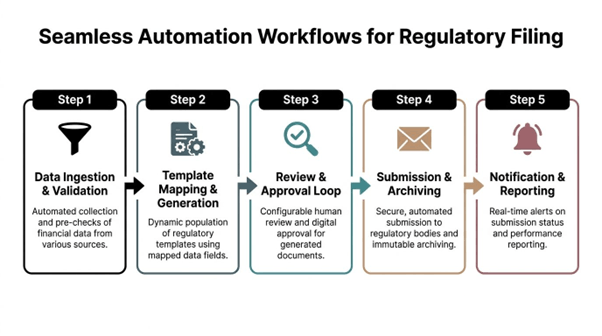
A practical end-to-end flow follows five stages. Data ingestion, validation, generation, review, then submission and archiving. That sequence sounds obvious, but firms still break it by leaving one or two steps manual.
Take a month-end or quarter-end reporting cycle.
The workflow starts with a scheduled trigger. It pulls approved data from the core banking platform, finance database, or data warehouse. If customer or entity metadata lives in Salesforce or another CRM, that data is pulled at the same time.
The system then runs pre-generation checks. Missing fields, invalid dates, out-of-range values, and mismatched entity mappings are flagged before a document is produced.
Only after those checks pass should the platform populate filing templates in bulk.
That generated output moves into a controlled review queue. Routine filings might be routed directly to a designated approver. Higher-risk filings can be escalated to compliance or legal. Once approved, the workflow distributes files to the required channel, whether that is secure email, a storage repository, an e-signature step, or regulator submission preparation.
There is no single integration pattern that fits every bank or insurer. The useful question is which model reduces manual dependencies without creating brittle custom code.
Common patterns include:
· API-triggered generation: Best when another application initiates filing or document creation.
· Database-driven batch runs: Useful for recurring reporting cycles with stable datasets.
· Event-based orchestration: Good when a status change or approval event should generate the next filing artifact.
· Hybrid model: Common in larger enterprises where some data arrives via API and some via scheduled exports.
Teams that need broader context on workflow design often benefit from adjacent compliance process thinking, not just document logic.
Generic workflow tools can move files around. They often struggle when the workflow includes document-specific logic, nested data structures, controlled approvals, and regulator-facing outputs in multiple formats.
Custom code has the opposite problem. It can do nearly anything, but each filing change becomes a maintenance event.
That middle ground matters. A platform should let IT integrate thoroughly while letting operations teams control business-friendly workflow rules. If you need examples of how that orchestration is typically set up, this guide on how to automate document workflows is a useful reference point for connecting generation, routing, and delivery.
A workflow is mature when the team can answer yes to these questions:
· Can the process start without a person launching it manually?
· Can failed validations stop generation before bad files spread?
· Can routine items move forward without everyone touching them?
· Can exceptions be routed to the right reviewer automatically?
· Can the final output be archived with naming, metadata, and status intact?
Implementation tip: Do not judge workflow quality by whether a document gets created. Judge it by what happens when data is incomplete, a reviewer is late, or a rule changes at the last minute.
That is the true test in regulated environments. Smooth days are easy. Good workflow design shows up on difficult days.
In finance, automation without controls is just faster exposure. If a filing engine generates the wrong output at scale, the problem gets bigger, not smaller.
That is why compliance architecture should be designed around three layers. Prevent errors early. make review traceable. Escalate judgment calls intentionally.

The safest time to catch a filing issue is before the document reaches a reviewer.
Good, automated controls include checks for:
· Field completeness
· Cross-field consistency
· Expected calculation relationships
· Valid date and reporting-period logic
· Jurisdiction-specific tagging or formatting rules
These controls should automatically run every cycle. Reviewers should not waste time finding avoidable formatting mistakes or broken mappings.
Just as important, every generated document should carry an audit story. Which source data was used, which template version produced the file, which rules fired, who reviewed it, and where it was sent. If you cannot reconstruct that chain quickly, the process is weaker than it looks.
One of the biggest gaps in current automation strategies is the lack of a defined Human-AI collaboration model for expert validation, especially for complex instruments or conflicting multi-jurisdiction regulations.
That gap shows up when firms either over-automate or over-review.
Over-automation assumes every filing can be handled the same way. That is risky for unusual products, conflicting interpretations, or new regulatory edge cases.
Over-review creates the opposite problem. Everyone touches everything, approvals become ceremonial, and risky items do not stand out.
A better model uses conditional routing:
|
Filing type |
Recommended handling |
|
Routine, low-variance filings |
Auto-generate with standard validations and targeted approval |
|
Medium-risk filings |
Route to designated reviewer when specific rules trigger |
|
High-complexity or cross-jurisdiction items |
Require expert review with documented rationale |
This is also why broader operational thinking around automating your business compliance is useful. The strongest teams do not separate document control from compliance control. They treat them as one continuous process.
Practical rule: Human review should focus on interpretation, exceptions, and accountability. Software should handle assembly, consistency checks, routing, and evidence capture.
An approval step is only useful if it creates evidence.
That means the system should record:
· Who approved or rejected
· When that action happened
· Which version was reviewed
· Any comments or exception notes
· What changed after review if anything
That is where approval workflow design matters as much as the document itself. Tools that support approval document workflow patterns are useful because they make sign-off part of the controlled process rather than an email side conversation.
The point is not to add bureaucracy. It is to create a review model that regulators, auditors, and internal risk teams can follow without guesswork.
Teams often first justify filing automation on labor savings. That is reasonable, but it is incomplete.
The bigger return comes from reducing rework, avoiding preventable errors, shortening review cycles, and making compliance operations less dependent on a few overloaded people. In regulatory environments, reliability has economic value even when it does not appear as a line item.
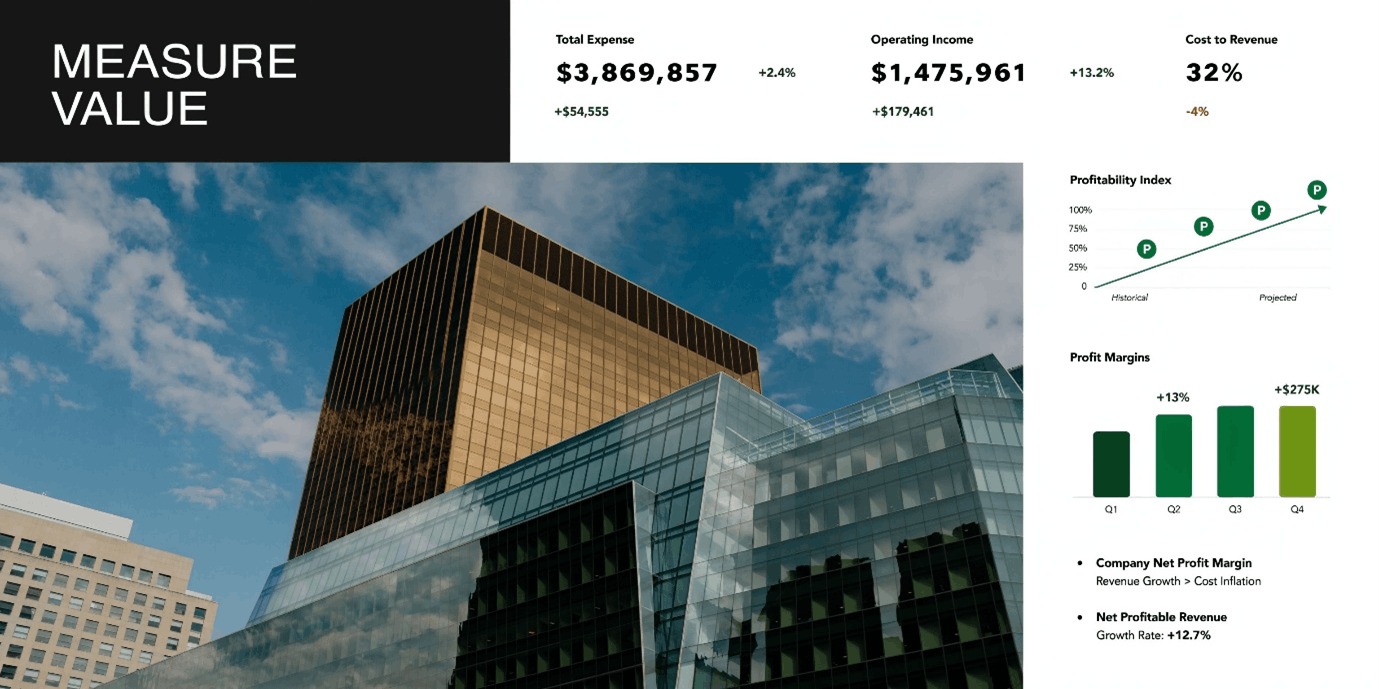
Manual regulatory reporting processes can have error rates of 10-25% , exposing firms to fines that average $10-20 million per major violation in the U.S. , and this analysis explains why automation changes the ROI equation through risk mitigation. You do not need many avoided errors for the business case to become clear.
Track ROI in four buckets.
Look at the process itself.
Measure:
· Manual preparation time
· Review cycle duration
· Time spent reconciling source mismatches
· Time from data ready to filing ready
Here, teams often see the first visible gains.
Look at what stops breaking.
Track:
· Internal review defects
· Rejected or returned filings
· Template correction frequency
· Post-generation manual edits
If users are still fixing generated documents by hand, the automation is not finished.
This is harder to express, but it matters most.
Watch for:
· Fewer exceptions reaching final review
· Cleaner audit evidence
· Faster response to regulator or auditor questions
· Lower dependence on spreadsheet-only controls
That is where platforms with workflow visibility and enterprise governance start to matter. Teams evaluating broader rollout often compare departmental fixes against more scalable options like enterprise document automation , where document generation, approvals, and integrations are managed more consistently across the organization.
Do not scale by copying a weak process to more teams. Scale by standardizing the control model.
A practical expansion path looks like this:
1. Start with one repeatable filing Choose a report with clear ownership and stable source systems.
2. Stabilize data and template logic Reduce manual edits until the automated output is trusted.
3. Formalize approvals and audit evidence Make the review trail clear enough for audit and compliance.
4. Replicate the pattern Apply the same integration, validation, and workflow model to adjacent documents.
A short product walkthrough can also help teams think through how document generation fits into wider operations before they expand further.
After the first successful filing automation, the conversation changes.
People stop asking whether automation can work. They start asking where else the same pattern applies. Annual investor statements, audit support packs, KYC files, policy packs, and lending documents often follow because the organization now has a repeatable method for combining source data, rules, approvals, and distribution.
That is the point where automate regulatory filing documents for finance stops being a narrow compliance project and becomes an operating capability.
If your team is still stitching together filings from spreadsheets, email approvals, and manually updated templates, it is worth taking a serious look at EDocGen . It gives enterprise teams a practical way to connect data sources, apply document logic without heavy coding, automate approvals and delivery, and build the auditability that finance operations need.