
In today's competitive insurance market, efficiency isn't just an advantage; it's a necessity. Manual processes, disconnected data, and administrative bottlenecks can cripple an agency's ability to grow and serve clients effectively. The solution lies in leveraging powerful, purpose-built insurance software for agents . This comprehensive guide moves beyond generic marketing claims to provide a detailed analysis of the top 12 platforms designed to streamline your operations.
This resource is your roadmap to finding the right fit. We dissect core features like document generation, CRM integration, and workflow management, offering practical use cases, honest assessments of limitations, and implementation guidance. Each platform review includes screenshots to help you evaluate your options thoroughly. The ultimate goal is to achieve true operational efficiency, which includes mastering the art of sales process automation to streamline client acquisition and management.
Whether you're an independent agent or a large brokerage, this listicle will equip you to make an informed decision that aligns with your specific operational needs and strategic goals. You will find clear comparisons to help you select the software that will unlock enhanced productivity and superior client service for your agency.
For agencies prioritizing operational excellence and precision in their client-facing materials, eDocGen’s Insurance Document Automation platform stands out as a powerful, specialized solution. It moves beyond generic CRM capabilities to focus intensely on one of the most critical, time-consuming aspects of an agent's job: generating accurate, compliant, and professionally branded documents at scale. This focus makes it an exceptional piece of insurance software for agents looking to solve specific workflow bottlenecks.
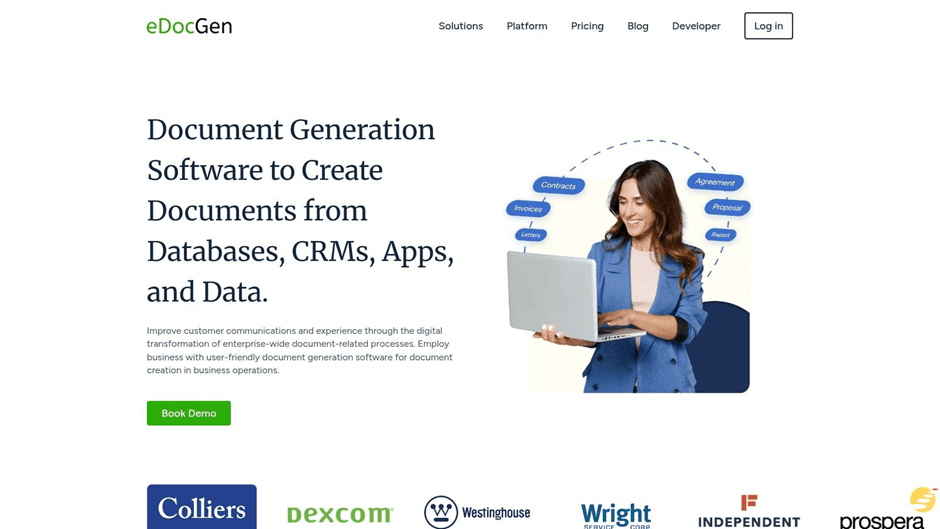
What truly sets this platform apart is its no-code, template-driven engine. Agents and operations staff can build and manage complex templates for policies, claims forms, and client agreements without needing IT intervention. The system uses conditional logic to dynamically insert or remove clauses, update client data, and perform calculations, ensuring each document is perfectly tailored.
This capability is invaluable for high-volume environments. An agency can, for instance, generate thousands of personalized renewal notices in minutes, each populated with data pulled directly from their existing CRM or database. This blend of user-friendly design and robust backend power makes it an indispensable tool for modernizing document-heavy insurance workflows. While there's an initial setup phase to integrate data sources, the long-term efficiency gains and reduction in manual errors present a significant return on investment.
|
Feature |
Analysis & Use Case |
|
Smart Template Management |
Enables agents to maintain brand consistency across all documents. A single change to a logo or legal disclaimer can be instantly applied to every template, saving hours of manual updates. |
|
No-Code Workflow Builder |
Business users can design complex document logic. For example, a life insurance policy template can automatically include or exclude specific riders based on the applicant's age or health data. |
|
Bulk Generation & Distribution |
Ideal for mass communications like annual policy summaries or compliance notifications. Generate thousands of documents and distribute them via email, e-signature, or print, all in one automated process. |
|
Data Security & Compliance |
Utilizes AES-256 encryption and supports on-premises deployment for agencies with strict data sovereignty requirements, ensuring sensitive client information remains protected and compliant with regulations. |
Pros:
Cons:
Learn more about how eDocGen's Insurance Document Automation can transform your agency’s operations.
Applied Epic stands out as a foundational agency management system (AMS) for agencies prioritizing scalability and a single, unified view of their entire operation. It is one of the most comprehensive insurance software for agents available, designed to manage the full client lifecycle, from sales and policy administration to accounting and servicing. Its strength lies in its robust, all-in-one architecture that eliminates the need for multiple disparate systems.
Agencies use Applied Epic to centralize customer data, automate routine tasks like renewals and endorsements, and gain deep business insights through advanced reporting. Its workflow automation is particularly powerful, allowing teams to create and enforce standardized processes across all lines of business, ensuring consistency and efficiency. The platform’s extensive carrier connectivity simplifies data exchange and policy downloads, significantly reducing manual data entry.
While its feature set is exhaustive, implementation is a significant undertaking that can be both time-consuming and costly, making it a better fit for established, growth-oriented agencies than for small startups. The user interface, while powerful, can have a steeper learning curve compared to more modern, streamlined platforms. Pricing is customized based on agency size and needs, requiring direct consultation.
EZLynx is a powerful, all-in-one insurance software for agents, renowned for its industry-leading real-time comparative rater. It excels in the personal lines space by integrating a user-friendly agency management system (AMS) with robust quoting tools, allowing agents to find the best carrier options for clients with a single data entry point. This integration of rating and management into one seamless platform is its key differentiator, significantly boosting efficiency for agencies focused on high-volume sales.
Agencies leverage EZLynx to automate the quoting process, manage customer relationships, and streamline policy servicing from a central hub. The platform includes a client self-service portal, automated tools to identify cross-selling opportunities, and integrated commission tracking. Its focus on a clean and intuitive interface makes it particularly accessible for teams that need to get up and running quickly without extensive training.
While EZLynx offers an exceptional user experience and is a leader in personal lines quoting, its third-party integrations are more limited compared to some enterprise-level systems. Some users have also reported occasional system slowdowns during peak business hours. Pricing is typically subscription-based and varies by the number of users and selected product modules, making it a scalable option for agencies of different sizes.
Jenesis Software carves out its niche as a highly accessible, web-based agency management system (AMS) tailored for small to mid-sized agencies that prioritize affordability and user-friendliness. It offers a strong balance of core functionalities designed to streamline daily operations and enhance client relationships without the overwhelming complexity of enterprise-level platforms. Its focus is on providing essential tools that help agents manage their book of business efficiently.
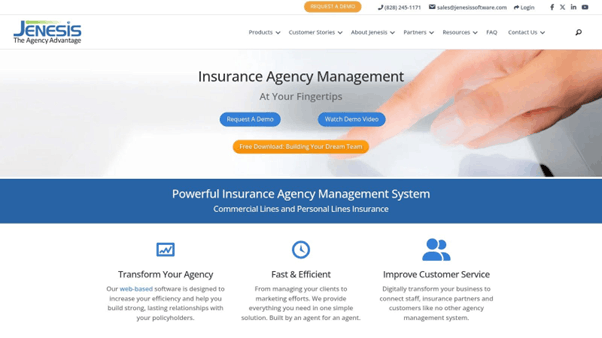
Agents leverage Jenesis to centralize client data, manage ACORD forms, and facilitate carrier downloads. Key differentiators include a built-in client portal for 24/7 policy access and integrated payment processing, features often found in more expensive solutions. The platform’s integrated marketing and email tools empower agents to run targeted campaigns directly from their AMS, making it a practical piece of insurance software for agents focused on growth through direct engagement.
While Jenesis excels in usability and affordability, it may lack the advanced automation, in-depth reporting, and extensive third-party integrations required by very large or highly specialized agencies. Its strength lies in its comprehensive yet straightforward approach, making it an excellent starting point for new agencies or a cost-effective alternative for established ones not needing enterprise-grade complexity. Pricing is transparent and based on the number of users, with a clear one-time setup fee.
AMS360 by Vertafore is a cornerstone agency management system known for its powerful, cloud-based architecture designed for growth-focused independent agencies. It excels at unifying agency operations, integrating everything from client and policy management to a sophisticated, insurance-specific accounting system. This integration allows agencies to operate from a single source of truth, eliminating data silos and improving overall business intelligence.
Agencies leverage AMS360 to streamline daily tasks through its robust workflow automation and renewal management tools. Its strong carrier connectivity is a key differentiator, facilitating real-time data exchange and downloads that dramatically reduce manual entry and errors. The platform's comprehensive document management capabilities also support a paperless environment, a critical component for modern efficiency. Efficient financial document automation is central to its value proposition.
AMS360 is a feature-rich platform, but this complexity means its implementation can be a significant project, requiring dedicated resources and time. The user interface, while comprehensive, may feel less modern and can present a steeper learning curve for new users compared to newer, more streamlined systems. Its pricing structure is generally geared toward established agencies, making it a substantial investment for smaller or startup operations.
HawkSoft has carved out a niche as a leading agency management system by championing a "human-friendly" approach to insurance software for agents. It is designed specifically for independent agencies that prioritize straightforward workflows and exceptional client service over complex, enterprise-level features. The platform is built on the philosophy that technology should enhance, not replace, the agent-client relationship, making it a favorite among small to mid-sized agencies.
At its core, HawkSoft provides robust tools for managing the entire client and policy lifecycle. Agencies leverage its intuitive interface for comprehensive document management, detailed client and policy tracking, and integrated accounting. A key strength is its reliable carrier download functionality, which automates the process of retrieving policy data from carriers, drastically reducing manual entry and ensuring data accuracy. The system is designed to be learned quickly, empowering staff to become productive with minimal training.
While HawkSoft excels in user-friendliness and core functionalities, it lacks some of the advanced automation, marketing, and analytical tools found in larger, more expensive platforms. This makes it less suitable for very large agencies with complex, multi-state operations requiring deep business intelligence capabilities. Pricing is generally considered affordable and is provided through direct consultation, reflecting its focus on the small to mid-sized agency market.
AgencyBloc is an agency management system that carves out a specific niche by focusing exclusively on the needs of life and health insurance agencies. This specialization makes it a powerful piece of insurance software for agents in that sector, offering highly relevant tools for client management, policy tracking, and, most notably, complex commissions processing. It’s designed to bring clarity and efficiency to agencies that often struggle with generic systems not built for their unique products and compensation structures.
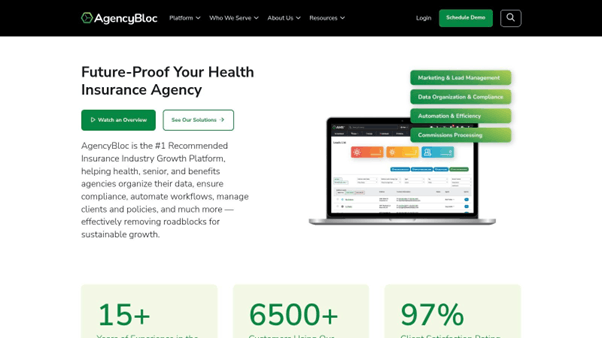
Agencies use AgencyBloc to automate everything from lead follow-ups to policy renewal reminders, freeing up agents to focus on sales and client relationships. Its integrated email marketing and robust reporting provide a complete toolkit for growth. The platform is frequently praised for its user-friendly interface and exceptional customer support, which helps agencies get up and running quickly with minimal friction.
The platform’s greatest strength is also its main limitation: its exclusive focus on life and health. Agencies that deal with Property & Casualty (P&C) lines will find it lacks the necessary features and workflows for those products. While excellent for its target market, it is not a one-size-fits-all solution for multi-line agencies. Pricing is subscription-based, with tiers determined by the number of users and features, requiring a direct quote.
NextAgency carves out a specific niche in the market by offering a streamlined agency management system (AMS) built explicitly for life and health insurance agencies. It differentiates itself by combining core CRM functionalities with robust commission management tools, addressing a critical pain point for brokers in this segment. The platform is designed to be an accessible, all-in-one solution for managing the entire client and policy lifecycle, from initial prospecting to ongoing service and commission tracking.
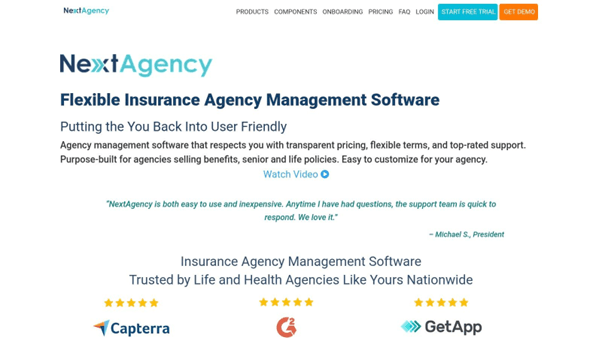
Agents use NextAgency to consolidate prospect and client data, manage policies, store important documents, and, most notably, automate complex commission calculations. Its user-friendly interface and straightforward setup process make it a popular piece of insurance software for agents who need a powerful tool without a steep learning curve or extensive IT overhead. The platform's focus on ease of use and affordability makes it a strong contender for smaller, specialized agencies.
While its specialization is a strength, it's also a limitation; the platform is not designed for P&C (Property and Casualty) agencies. Larger life and health agencies might find it lacks the advanced, enterprise-level features or extensive integration capabilities of more comprehensive systems. Pricing is transparent and tiered, starting with a free plan for single users, making it exceptionally accessible for independent agents or small startups.
InsuredMine positions itself not as a replacement for an Agency Management System (AMS), but as a powerful sales and marketing add-on designed to sit on top of it. It excels at enhancing the client experience through robust CRM, sales automation, and engagement tools. This platform is built for independent agents who want to modernize their client interactions and supercharge their growth without overhauling their core operational system.
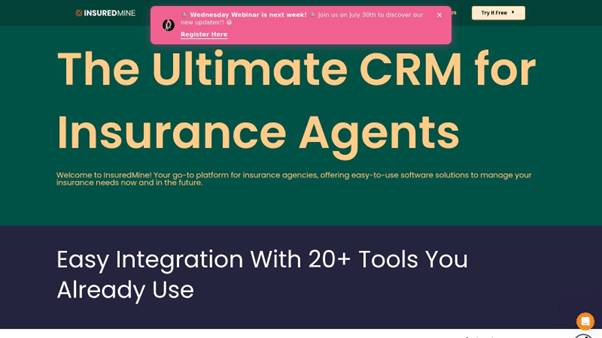
Agents leverage InsuredMine to automate sales pipelines, manage leads, and deploy targeted marketing campaigns through email and SMS. Its standout feature is the branded client portal and mobile app, which empowers policyholders with self-service options, increasing both engagement and retention. While InsuredMine offers powerful tools, it’s important to understand how its features can complement other solutions; for a deeper dive into modernizing client communications, you can learn more about insurance document automation . This focus on the front-end sales and service experience makes it a unique piece of insurance software for agents aiming for a digital-first approach.
The platform's strength is its ability to seamlessly integrate with many popular AMS platforms, augmenting their capabilities rather than replacing them. However, this means it is not a standalone solution and agencies must already have a functioning AMS. The user interface is widely praised for being modern and intuitive, which simplifies adoption. Pricing is not publicly listed and requires a direct consultation to create a package based on an agency’s specific needs and size.
BindHQ is a highly specialized, cloud-native agency management system built specifically for the unique operational demands of Managing General Agents (MGAs), Managing General Underwriters (MGUs), and wholesale brokerages. It distinguishes itself from general-purpose insurance software for agents by focusing on the high-volume, complex transactions characteristic of the wholesale market. The platform integrates core agency functions into a single, cohesive workflow to accelerate the bind-to-issue lifecycle.
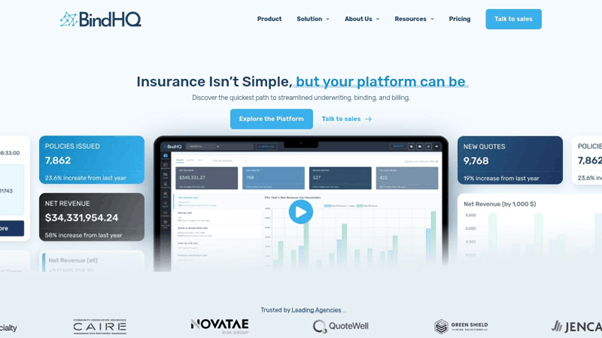
Wholesale brokers use BindHQ to manage submissions, generate quotes with its integrated comparative rater, handle policy administration, and run all accounting and billing from one place. Its architecture is designed for speed and efficiency, helping users bind more business and improve profit margins. The platform’s cloud-based nature ensures continuous updates and accessibility, allowing teams to operate effectively from any location without managing on-premise servers.
While its specialized feature set is a major advantage for its target market, it makes BindHQ less suitable for standard retail agencies. The system’s complexity and higher starting price point reflect its focus on wholesale operations, which may be prohibitive for smaller, simpler organizations. The platform is designed for a specific niche and excels within it, but its capabilities may be excessive for agencies outside the MGA or wholesale space.
Agency Matrix delivers a straightforward, web-based agency management system that distinguishes itself through its transparent, flat-fee pricing model. Designed for accessibility and scalability, this insurance software for agents is an attractive option for small to mid-sized agencies that need core functionalities without the complexity or high cost of enterprise-level platforms. Its architecture is built to support agencies with single or multiple office locations, providing essential tools under one roof.
Agents leverage Agency Matrix for centralizing policy and claims data, managing billing and accounting, and generating automated reports to track performance. A key feature is its integrated premium finance center, which simplifies the process of offering and managing financing options for clients. The platform's multi-office customization allows agencies to tailor settings and workflows to specific branch needs, ensuring operational consistency while accommodating local differences.
While its scalability and predictable pricing are major advantages, Agency Matrix has some limitations. The platform charges additional fees for initial data conversion and account activation, which agencies must factor into their budget. Its feature set, while solid for core operations, may lack some of the advanced automation, marketing, and third-party integration capabilities found in more premium systems. The user interface is functional but can feel less modern compared to newer competitors.
Total CSR shifts the focus from managing policies to managing people, positioning itself as an essential tool for standardizing agent and CSR performance. Unlike traditional agency management systems, this platform is a specialized insurance software for agents dedicated entirely to onboarding, training, and compliance. It addresses a critical operational bottleneck: ensuring every team member, from new hires to seasoned veterans, delivers a consistent and high-quality client experience.
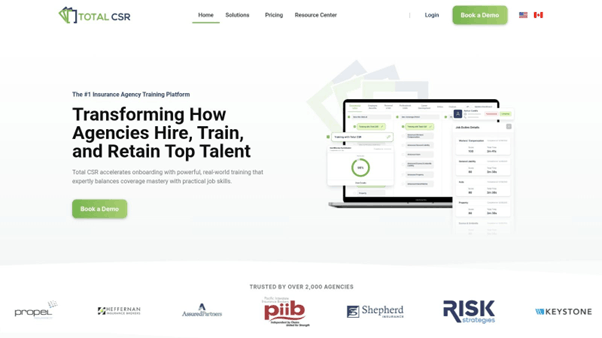
Agencies use Total CSR to deploy practical training modules, assess staff skills, and track compliance certifications in one centralized location. Its integrated hiring tools help identify promising candidates, while performance analytics offer insights into team development. This standardization frees up senior staff from repetitive training tasks, allowing them to concentrate on high-value activities. The platform is particularly effective for agencies looking to build a scalable, repeatable process for team excellence and operational consistency.
Total CSR is a powerful supplement to, not a replacement for, a core agency management system. It excels at people development but does not handle policy administration, accounting, or client management. Its focused nature means agencies will need other software for their day-to-day operations. Pricing is customized and may represent a significant investment for smaller agencies or those with very low staff turnover.
|
Solution |
Core Features |
User Experience / Quality |
Target Audience |
Unique Selling Points |
Price & Deployment |
|
Insurance Document Automation |
Smart template management, bulk generation, multi-lingual, AES-256 security, conditional logic, no-code |
No-code interface, high-volume efficiency, brand governance |
Insurance providers, enterprises |
Flexible deployment (cloud/on-prem), strong security, automated workflows |
Custom pricing, flexible deployment |
|
Applied Systems – Applied Epic |
End-to-end policy management, document version control, workflow automation, reporting |
Scalable, robust integration, comprehensive |
Insurance agencies of all sizes |
Strong carrier connectivity, third-party integration |
Higher cost, complex implementation |
|
EZLynx |
Multi-carrier quoting, client portal, cross-selling, document delivery |
User-friendly, support focused |
Personal lines insurance agencies |
Single data entry quoting, excellent support |
Mid-range pricing |
|
Jenesis Software |
Client portal, email marketing, ACORD forms, payment processing |
Affordable, user-friendly |
Small to mid-sized agencies |
Affordable pricing, comprehensive training |
Affordable pricing |
|
AMS360 by Vertafore |
Policy management, accounting, renewals, carrier communication, reporting |
Robust features, strong carrier access |
Independent insurance agencies |
Comprehensive reporting, workflow automation |
Higher cost, complex setup |
|
HawkSoft |
Document management, policy tracking, reporting, accounting |
Intuitive interface, strong support |
Small to mid-sized agencies |
Affordable, easy-to-use |
Affordable pricing |
|
AgencyBloc |
Client & policy management, commissions, workflows, reporting |
User-friendly, industry-specific |
Life and health insurance agencies |
Focused on life & health, excellent support |
Mid-range pricing |
|
NextAgency |
CRM, commissions, client & policy management, reporting |
Easy to use, customizable |
Health and life insurance agencies |
CRM and commission tools, affordable |
Affordable pricing |
|
InsuredMine |
CRM & sales automation, client engagement, analytics, mobile app |
User-friendly, strong integrations |
Independent agents and carriers |
Omnichannel client experience |
Pricing not publicly listed |
|
BindHQ |
Comparative rater, policy management, accounting, integrations |
Cloud-based, continuous upgrades |
MGAs, MGUs, wholesale brokerages |
Designed for MGAs, flexible cloud platform |
Higher starting price |
|
Agency Matrix |
Multi-office customization, premium finance, reporting, billing |
Scalable subscriptions |
Insurance agencies with multiple offices |
Flat fee per office, customizable |
Subscription-based |
|
Total CSR |
Training, compliance, hiring tools, performance analytics |
Standardizes training, enhances hiring |
Insurance agencies focusing on staff training |
Focus on onboarding & consistency |
Pricing varies |
Navigating the crowded market of insurance software for agents can feel overwhelming, but making an informed choice is a critical step toward future-proofing your agency. We've explored a wide spectrum of solutions, from enterprise-level powerhouses like Applied Epic and Vertafore's AMS360 to user-friendly, growth-focused platforms such as AgencyBloc and HawkSoft. The key takeaway is that there is no single "best" platform; there is only the best fit for your specific operational needs, client base, and strategic goals.
Your decision-making process should be as methodical as your risk assessments. The ideal software isn't just about flashy features; it's about solving core business problems. Does your team waste hours on manual data entry? A system with strong automation and CRM integration like EZLynx or InsuredMine could be transformative. Are you a smaller agency needing an all-in-one solution that’s easy to implement? Jenesis Software or NextAgency might offer the perfect balance of functionality and simplicity.
Choosing the right software is just the beginning. A successful transition requires a clear, strategic plan. To ensure you select and implement a system that empowers your team and drives growth, follow these critical next steps.
Ultimately, selecting the right insurance software is an investment in your agency's efficiency, scalability, and client satisfaction. By grounding your decision in a thorough understanding of your unique needs and conducting diligent, hands-on research, you can confidently choose a partner that will not only streamline your current operations but also serve as a foundation for sustained success.
Ready to supercharge one of the most critical parts of your agency’s workflow? While a full AMS manages your entire agency, perfecting your document generation process with a specialized tool can provide an immediate ROI. EDocGen integrates seamlessly with your existing systems to automate the creation of proposals, policy documents, and compliance forms, saving your team hundreds of hours. Discover how you can elevate your document strategy by visiting .