
API-first document generation for enterprises turns document production into a governed, reusable service.
A familiar enterprise scene goes like this. A deal reaches the final approval stage. Legal needs the latest contract language. Sales needs regional pricing language. Finance needs the billing schedule inserted correctly. Someone exports data from Salesforce, someone else copies it into Word, and another person converts the file to PDF before sending it for signature.
That process works until volume rises, regions expand, or regulators ask for proof. Then every manual step becomes a failure point.
The market has already moved past that pattern. Template-based and API-driven document generation platforms now generate over 4.2 billion documents annually, and 80% of mid-to-large organizations use templated solutions, with API-based integrations accounting for 49% of enterprise deployments according to document generation automation statistics and trends.
That matters because it reflects a design shift, not just a tooling trend. Enterprises are treating documents as system outputs tied to workflow events, source data, approvals, and delivery channels.
If your team is still asking users to download records, edit templates manually, and upload finished files back into a CRM, you do not have a document process. You have a bottleneck.
A useful baseline is understanding what document generation is in practical enterprise terms . Once teams see documents as structured outputs from business systems, the path forward gets clearer.
Traditional document products often bolt on an API after the core product is already built. The result usually shows up in the hard parts. Version control gets messy, error handling is vague, bulk generation strains the platform, and template changes drift away from application logic. An API-first model starts from a different design assumption. The document service exists to be called by other systems in a controlled, testable way.
API-first means the API defines the operating contract for document generation. It specifies how data is submitted, how templates are selected, how rendering options are passed, what file types are returned, and what happens when validation fails. That matters because enterprise teams need more than document output. They need predictable behavior that can survive audits, release cycles, and integration changes across CRM, ERP, policy admin, and workflow platforms.

In older implementations, document logic gets buried inside one application or one custom script. Data mapping, template rules, rendering, delivery, and storage end up tightly coupled. A change to one step often forces retesting across the whole chain. That is expensive in any enterprise. It is worse in banking, insurance, and real estate, where each change may also trigger legal review or control validation.
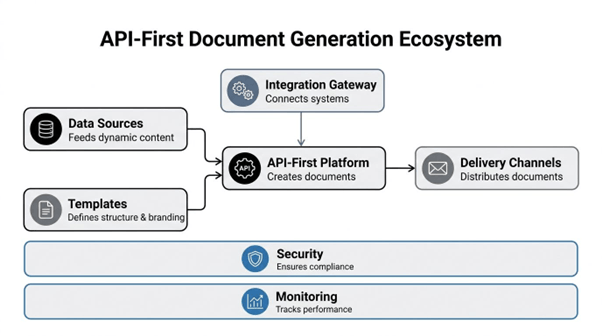
An API-first model separates those concerns cleanly. The CRM or core system supplies data. The template layer manages presentation and conditional content. The rendering service produces PDF, Word, Excel, or presentation output. Delivery and e-sign happen through their own connected services. The API is the stable interface between them.
That separation changes how teams work:
· Developers integrate document generation into business workflows without embedding template logic in application code.
· Business analysts update approved language and conditional rules in governed templates instead of filing development tickets for every revision.
· Operations teams trigger generation from workflow events, batch jobs, or case milestones.
· Compliance and legal teams review a controlled template source with clear version history.
A platform can claim API support and still create operational risk. In practice, many “API-enabled” tools expose only a basic export endpoint or mirror a UI workflow that was never designed for system-to-system use. That pattern breaks down during migration, scale-up, and audits.
Enterprise teams should expect the API to handle:
· Structured payloads from JSON or XML
· Bulk generation without fragile client-side orchestration
· Consistent output behavior across Word, PDF, Excel, and presentations
· Versioned contracts that do not change every time the UI changes
· Clear error responses that support monitoring and retry logic
· Event-driven integration with CRMs, ERPs, databases, queues, and workflow tools
Those details determine whether the service reduces long-term cost or adds another integration.
For technical teams evaluating platforms, a practical document generation API architecture and workflow model is a useful reference point. The right question is simple. Does the API control the document process in a way that can be tested, governed, and audited, or does it just expose a few actions from a UI-first product?
Practical rule: If template changes still require developers to remap fields, rewrite logic, or manually reconcile output behavior across systems, the implementation is not API-first.
Executives do not buy API-first document generation because APIs sound modern. They buy it because manual document operations drain margin, slow revenue, and create risk.
Three benefits matter most.
The first gain is operational. Document generation moves from user-driven busywork into automated workflow execution.
That matters in every function. Sales can trigger proposals directly from CRM data. HR can generate offer letters from approved records. Finance can produce invoices and statements without batch handoffs between teams.
But speed alone is not the whole story. You also need to avoid replacing manual work with expensive integration sprawl. API platforms can cut manual effort by 70% , yet a 2026 G2 review analysis of over 500 tools found that 42% of enterprises face hidden TCO from API versioning conflicts according to analysis of how API-first is shaping modern business.
The lesson is straightforward. Automation pays off when the platform reduces both human effort and integration maintenance.
Centralized templates change governance from reactive to controlled.
Instead of reviewing dozens of local document copies, legal and compliance teams can approve one governed version. Instead of discovering brand drift after a customer receives the wrong file, operations can lock formatting, clauses, and calculations into the generation layer.
That reduces the most common enterprise failure pattern. People editing “just one version” for a special case, then reusing it later as if it were approved.
Customers rarely care about your architecture. They do care when onboarding documents arrive quickly, accurately, and in the right language. Employees care when they do not need to re-enter the same data across systems.
Here is the business case in plain language:
|
Business concern |
Weak document process |
API-first outcome |
|
Revenue cycles |
Approvals stall waiting for manual prep |
Documents trigger from system events |
|
Compliance |
Multiple uncontrolled templates circulate |
Approved logic stays centralized |
|
Service quality |
Delays, formatting errors, inconsistent language |
Faster, cleaner, personalized outputs |
For CFOs and COOs, this is not a back-office upgrade. It is process infrastructure.
The cleanest enterprise document architectures do one thing well. They separate document generation from the systems that initiate it, while keeping data flow tightly controlled.
That sounds abstract until you map the pattern.
A common pattern starts with a business event. In Salesforce, an opportunity reaches Closed-Won. In a loan system, an application enters underwriting. In HRIS, a candidate status changes to approved.
That event calls the document API, which pulls or receives the relevant data payload, applies a governed template, and returns the output for delivery or storage.
This pattern works well when timing matters:
· Sales contracts
· Offer letters
· Customer welcome packs
· Regulatory disclosures tied to workflow milestones
The architecture is straightforward. Trigger, transform, render, deliver.
Some workloads are not interactive. They are scheduled and high volume.
For these situations, API-first design becomes a significant architecture decision rather than a convenience feature. Cloud-based APIs can shift the job of generating 50,000 personalized invoices from a local process that takes hours into a parallelized API workflow that completes in a fraction of the time.
That pattern matters for:
· Monthly statements
· Policy renewals
· Bulk notices
· Portfolio reports
· Region-specific contract packs
What usually breaks these projects is not rendering. It is weak integration design.
When teams skip formal API contracts, they end up reverse-engineering payload expectations from code, patching around template changes, and arguing over which field is authoritative. A contract-first approach avoids that.
Strong teams define:
The payload schema
The required and optional fields
The output behavior
Error handling
Versioning rules
That gives developers and business analysts a common reference point.
For organizations connecting many systems, the practical next step is to review available enterprise integration options and decide which flows should be real-time, which should be asynchronous, and which need middleware for data shaping.
Tip: Put transformation logic close to the integration layer, not inside dozens of templates. Templates should express business presentation rules, not compensate for poor source-system design.
A durable document factory usually includes these components:
· Source systems: CRM, ERP, LOS, HRIS, databases
· Integration layer: event triggers, middleware, or direct API calls
· Template repository: approved documents with version control
· Generation engine: renders PDF, Word, Excel, or presentation outputs
· Delivery layer: email, e-sign, print, archive, or cloud storage
· Monitoring and logging: tracks failures, retries, and throughput
The exact stack can vary. The pattern rarely does.
A compliance review usually exposes the same pattern. Customer data sits in the CRM, rates live in another system, approved language is stored somewhere on SharePoint, and staff still email draft documents for signoff because that is how the process evolved over time. In regulated industries, that setup creates audit gaps, version drift, and unnecessary data exposure.
Security concerns are valid here. Contracts, loan disclosures, policy files, patient-facing forms, and employee records carry legal and privacy obligations. The mistake is treating familiar manual steps as a control framework when they often make control harder to prove.

An API-first document service gives security and compliance teams one governed execution path instead of dozens of unofficial ones. That matters in enterprise environments where auditors ask who generated a document, which template version was used, what source data was pulled, and whether the output was retained or deleted according to policy.
When document generation runs through a controlled service, teams can enforce:
· Role-based access
· Template-level controls
· Encryption in transit and at rest
· Auditable request and response logging
· Retention and deletion policies tied to document class
That is the practical advantage. Security becomes part of the workflow design, not an after-the-fact review.
The primary blocker is rarely the API itself. It is uncertainty about residency, key management, audit evidence, and vendor review. Enterprises in banking, insurance, healthcare, and real estate all ask variations of the same question: can this platform fit our control model without forcing teams back into manual workarounds?
A useful way to frame the review is to map each concern to an explicit platform capability:
|
Compliance concern |
What teams need |
|
Data residency |
Clear deployment options and storage boundaries |
|
Encryption |
Protection for data in transit and at rest |
|
Auditability |
Immutable records of who generated what and when |
|
Access control |
Granular permissions across templates and outputs |
|
Vendor risk |
Security documentation that stands up to enterprise review |
That table looks simple. The implementation is not. For example, audit logging is only helpful if log events can be retained, searched, and correlated with upstream business transactions during an internal review or regulator inquiry.
Generic modernization advice tends to assume cloud is the obvious destination. Enterprise teams in regulated environments know the answer is more conditional.
Cloud delivery can reduce operational overhead and simplify scaling. On-premises or private deployment can make sense when internal policy, client contracts, or regional rules set hard limits on where data can be processed or stored. The trade-off is straightforward. Cloud usually wins on speed of rollout and platform operations. Controlled deployment models often win on policy alignment and reviewability.
Healthcare organizations evaluating document automation often start with the requirements for HIPAA-compliant document generation software . The same governance questions then show up in finance, insurance, and life sciences, just with different terminology and control frameworks.
Key takeaway: Security improves when document generation is treated as a governed service with defined access rules, encryption, audit evidence, and deployment options that match policy.
The value of API-first document generation becomes obvious when it is tied to real business workflows. The mechanics differ by industry, but the pattern stays the same. A system event occurs, trusted data is assembled, a governed template is rendered, and the result moves immediately to the next step.

In banking, the old process is still common. A loan officer gathers borrower details, operations checks product terms, legal confirms disclosure language, and someone assembles the package manually from several files.
That is slow, but the bigger problem is inconsistency. The wrong rate table, a stale disclosure, or a missing annex can create downstream rework or a compliance issue.
An API-first approach fixes the handoff points. The loan origination system becomes the source of truth for borrower and deal data. Approved templates hold disclosure logic, conditional sections, and calculations. When the application reaches the right stage, the package is generated and routed automatically.
The result is not just faster output. The process becomes inspectable.
Insurance teams face a different complexity. Policies often require product-specific wording, state or regional variations, rider selection, and multilingual output. Agents and operations staff should not be assembling those documents by hand in the field or at the branch.
API-first generation lets policy systems pass structured data into templates that already know which clauses to include, which schedules to expand, and how to present the final document set. That reduces the informal workaround culture where agents keep old forms locally because they are “close enough.”
A short product walkthrough can help teams visualize how generated files move into signature and distribution workflows:
Real estate teams often have the clearest trigger points. Proposal accepted. Opportunity advances. Lease terms approved. Each stage should produce a different document set from the same core data.
Without API-first integration, teams export records from Salesforce, edit document templates manually, and email draft files back and forth. That is manageable in a small office. It breaks quickly at regional or enterprise scale.
With an API-first approach, Salesforce events can trigger proposal packs, lease drafts, amendment documents, or closing packets using governed templates and current data. The generated files can then move to review, e-sign, storage, or print distribution without recreating the same data in multiple places.
Practical test: If a team can explain a workflow trigger in one sentence, it is usually a good candidate for document API automation.
A regulated enterprise usually discovers the limits of its document platform during audit season, not during a product demo. A template changed without approval. An integration broke after a field rename. Legal wants proof of which version generated which customer notice, and the answer lives across tickets, email threads, and custom code.
That is the standard to judge an API-first document platform. It has to hold up under scale, change control, and review.
Enterprise document programs fail in familiar ways, and the root cause is often governance rather than rendering quality.
· Integration logic becomes too specific to one workflow or one team.
· Template edits require developer time for routine business changes.
· Version control is split across shared drives, code repos, and local copies.
· Security or architecture review rejects the deployment model late in the project.
· Operations teams cannot support production issues without pulling in IT.
An API endpoint alone does not solve that. The platform still needs to handle nested data, conditional clauses, loops, calculations, output formats, and downstream delivery without turning every document change into an application change. In regulated industries, it also needs a clean answer to a harder question. Who changed what, when, and under whose approval?
For high-volume and regulated environments, the evaluation checklist is practical:
|
Capability |
Why it matters |
|
Mature REST API |
Lets applications trigger generation in a predictable way |
|
Support for JSON, XML, spreadsheets, and databases |
Cuts down field mapping and custom transformation work |
|
No-code template control |
Lets business teams handle approved content changes without dev tickets |
|
Bulk generation support |
Covers statements, renewals, notices, and batch correspondence |
|
Multi-format output |
Supports PDF, Word, Excel, and presentation requirements |
|
Deployment flexibility |
Fits cloud, hybrid, or on-premises policy requirements |
EDocGen aligns well with that model. It provides a document generation API for enterprise systems, supports document creation from JSON, XML, Excel, and database sources, and gives business users no-code template tagging with loops, conditional logic, and calculations. It also supports bulk generation, multilingual output, centralized template governance, and deployment across cloud or on-premises environments.
That combination matters for total cost of ownership. If developers own every integration and analysts own none of the document logic, the backlog grows. If business users can edit everything without guardrails, audit findings grow. Enterprise teams need both control and separation of duties.
API-first maturity shows up after go-live.
The ultimate test is whether the document service behaves like a governed enterprise component instead of a helpful utility bolted onto a workflow. Teams need stable contracts, clear versioning, predictable error handling, and an implementation model that survives template updates, schema changes, and release cycles across multiple systems. Without that discipline, each new document set adds another exception path to support.
This is also where migration risk becomes visible. Many enterprises are replacing a mix of mail-merge processes, legacy composition systems, and department-built tools. A platform that supports structured inputs, reusable templates, and controlled rollout patterns reduces the need for a big-bang cutover. Teams can migrate one document family at a time, keep approval controls intact, and retire old tooling in phases instead of carrying duplicate operating costs for years.
For teams in banking, insurance, real estate, HR, and life sciences, the useful combination is:
· A predictable API contract for developers
· Controlled template authoring for analysts and operations
· Security features that fit enterprise review
· Deployment options that respect data residency and policy
· Capacity for both one-off and batch generation
That is what separates a tool with an API from a document platform that can stay in production under compliance pressure.
If your team is comparing platforms and wants to see how this works in a governed enterprise setup, schedule an EDocGen demo for your document workflow .
Selection rule: Choose the platform that removes unnecessary handoffs between developers, business analysts, and compliance reviewers. That is where document automation programs usually lose time and money.
Many teams do not need a massive transformation program to get started. They need one painful workflow, one clean template set, and one reliable integration path.
A practical rollout usually follows three steps.
Pick a document process that is both repetitive and visible. Sales proposals, lending packages, policy documents, onboarding forms, and HR letters are common starting points.
Avoid the temptation to begin with the most politically complex workflow in the company. Choose one where the trigger, source data, and approval path are already understood.
Many document projects fail because teams start redesigning the document before they confirm which system owns the data.
Identify:
· The source of truth
· The trigger event
· The required fields
· The approval requirements
· The delivery destination
Once those are clear, template design becomes much easier.
If developers love the API but business users cannot maintain templates, the backlog returns. If business users love the editor but the API is weak, integrations become brittle.
The right platform balances both. If your team is evaluating options and wants to see how that looks in a real environment, book an EDocGen demo .
API-first document generation for enterprises is not primarily about documents. It is about operational control. When the generation layer is governed, integrated, and scalable, contracts move faster, policies stay compliant, and teams stop rebuilding the same process by hand.
If your current workflow still depends on manual exports, local templates, and last-minute document fixes, now is the right time to modernize it. EDocGen helps enterprises automate high-volume, governed document generation across CRM, database, and business application workflows while supporting the deployment and compliance needs regulated teams care about.