
What if you could build a complex contract not by hunting for old templates and nervously copying-and-pasting, but just by answering a few simple questions? That's the magic of document assembly software. It's a tool that completely automates how you create customized, perfect documents using smart templates—turning a slow, risky process into a fast, reliable one.
For too many businesses, creating critical documents like proposals, NDAs, or reports is a frustrating grind. The usual routine involves finding a similar document someone made last quarter, saving a new copy, and then meticulously swapping out old details for new ones. This "find and replace" workflow isn't just inefficient; it's a huge source of business risk.
It's incredibly slow, demands intense focus to avoid mistakes, and often leads to inconsistent quality. A tiny oversight—like leaving in a previous client's name or an old dollar amount—can have disastrous financial or legal fallout. In fact, countless studies show that even minor manual data entry errors can have a real impact on revenue.
Need a contract for a client in California instead of New York? The software automatically pulls in the correct state-specific clauses. Is the deal value over a certain amount? It instantly adds the required executive approval section. No guesswork needed.
This automated approach guarantees every document is built perfectly according to your pre-approved rules and templates. By turning your static Word docs into intelligent, active assets, document assembly software lets your business operate with more speed, precision, and confidence. It’s the tool for any company serious about optimizing critical workflows and hitting new levels of productivity.
Think of it like working with a set of smart LEGO blocks instead of a static, pre-built model. First, you create the individual blocks—the dynamic clauses, paragraphs, and bits of data. Then, when it’s time to build, the software acts like a master builder, grabbing the perfect combination of blocks to create a flawless, unique structure every time.
Everything starts with creating a smart template. This isn't your average Microsoft Word or Google Docs template where you just fill in a few blanks. A smart template is an intelligent blueprint for your documents, acting as the single source of truth for every version you'll ever create.
To build one, you take an existing standard document—say, a sales contract or an employee offer letter—and mark it up with special placeholders and rules. These aren't just empty fields; they are dynamic elements that tell the software exactly what to do.
This "markup" process involves a few key components:
This infographic breaks down how these pieces fit together into a clean, simple workflow.
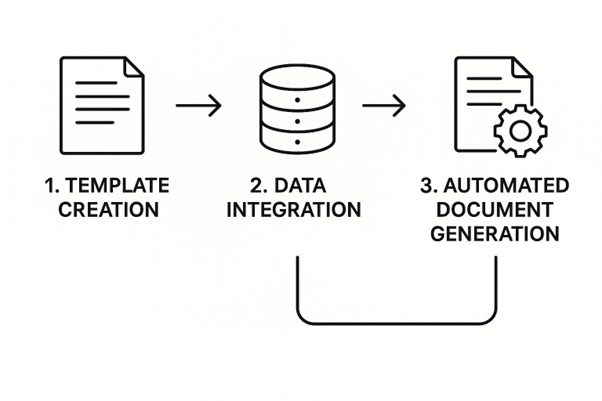
As you can see, the process moves from a one-time template setup to effortless, repeatable document generation. Once that template is built, it becomes a reusable asset that powers all future documents, locking in consistency and accuracy across the board.
Once the smart templates are built and stored, the creation process for the end-user becomes incredibly straightforward. Instead of cracking open a Word doc and manually hunting for text to edit, the user interacts with a simple, interview-style form.
This interface is basically a dynamic questionnaire. The user just answers a series of plain-language questions, and the software works behind the scenes to gather all the necessary information.
For instance, a sales manager creating a proposal might answer questions like:
As the user provides these answers, the document assembly software instantly gets to work. It pulls the corresponding data and applies the pre-defined conditional logic to make decisions on the fly. It selects the correct service descriptions, calculates totals, and slots in the appropriate legal clauses based on the client's location.
The real beauty of this is that the user doesn't need to know any of the complex rules or legal nuances. They just provide the core information, and the software handles the rest, constructing a perfect, compliant, and fully customized document in seconds.
When you start looking at document assembly software, you’ll notice a big difference between the basic tools and the heavy hitters. A simple platform might just fill in a few blanks, but a true enterprise solution is packed with powerful features built to manage complexity, lock down compliance, and grow with your business.
Knowing what these core features do is the key to picking the right platform. They’re the gears in the machine, working together to turn a static template into a smart, automated workflow.
Right at the top of the must-have list is conditional logic. This is the “if-this-then-that” brainpower that lets one single template morph to fit hundreds of different situations. Think of it like a tiny decision-maker built right into your documents.
For instance, a sales agreement template could use conditional logic to automatically:
This one feature gets rid of the need to manage dozens of nearly identical templates. It slashes administrative work and kills the risk of someone grabbing an old, outdated version. The right content shows up every time, no manual check needed.
Another game-changer is the clause library. This is a central, pre-approved vault of standard text, legal paragraphs, and content blocks you can drop into any document. It becomes the single source of truth for your most critical language.
This is a non-negotiable for legal, HR, and finance teams where every word counts. A clause library stops employees from winging it with their own wording or, worse, copying and pasting from an old contract they found on their desktop.
By locking down approved language in a clause library, you gain powerful control over compliance and brand consistency. It ensures that every contract, proposal, and agreement leaving your organization meets your exact legal and branding standards.
Business today is interconnected, and your documents should be too. The best document assembly platforms offer rock-solid data integration. This allows the software to talk directly to your other essential business systems.
Common connections include:
This smooth flow of information doesn't just save a ton of time; it guarantees the data in your final documents is always right. The ability to link up these systems is a true mark of a mature document generation solution.
Finally, a top-tier platform puts you in the driver's seat when it comes to the final product. Your documents represent your brand, and the software should spit out perfectly formatted files in whatever format you need, without any fiddling around.
This means the software can handle tricky formatting rules, like tables that automatically expand based on the data, or instantly generate a table of contents for a long report. It also gives you total flexibility on the output.
Whether you need a polished PDF for a client, an editable Word doc for negotiations, or even a PowerPoint slide, the system should create it flawlessly with a single click. This feature ensures your automated documents always look professional, closing the loop on a truly hands-off workflow.
It’s not just about speed; it’s about control, accuracy, and building a scalable process you can trust.
The real power of document assembly software isn't just a list of features on a webpage; it’s about the tangible results you see day-to-day across different industries. We're talking about concrete advantages that completely change how work gets done. Whether it’s a law firm, a bank, or an HR department, the story is surprisingly consistent: massive time savings, a huge drop in human error, and much tighter compliance.
This is more than a small tweak to your workflow. It's a fundamental shift in how your most valuable people spend their time. When you automate the soul-crushing, repetitive parts of creating documents, you free up your skilled professionals to focus on the strategic work that actually grows the business. The market is certainly taking notice. The global document creation and assembly software market hit around USD 6.9 billion in 2023 and is expected to more than double to USD 14.5 billion by 2033. You can dig into the numbers in this detailed report on DataHorizzon Research.
In the legal field, time is literally money, and there's zero room for error.
Using a library of pre-approved clauses and smart conditional logic, a paralegal can generate a complex contract that works across multiple states in minutes, not days.
For legal pros, the biggest win is mitigating risk. The software acts like a vigilant gatekeeper, ensuring every document is up to code. This frees up lawyers to focus on negotiation and strategy instead of playing proofreader.
The entire financial services industry is built on precision and following the rules. Loan agreements, mortgage applications, compliance reports—they all have to be perfect. A single misplaced decimal or a wrong interest rate can lead to huge financial losses and nasty regulatory fines.
This is where document assembly software becomes an engine for accuracy. It can connect directly to core banking systems and CRMs to pull client data, account numbers, and financial figures automatically, which means no more manual data entry. Our guide on financial document automation dives deeper into these uses. The result is that every statement or loan package that goes out the door is spot-on.
From offer letters and employment contracts to onboarding packages, consistency is everything for creating a fair and compliant employee experience.
With document assembly software, an HR manager can create a complete, personalized onboarding packet for a new hire in just a few clicks. The system grabs the candidate’s info, pulls the right employment forms for their state, and adds all the relevant company policies.
This kind of standardization delivers some serious benefits:

Picking the right document assembly software is a major business decision, not just another IT purchase. The right platform should feel like a natural extension of your team, slotting right into your existing workflows and growing with you. Getting it wrong can lead to frustrated teams, clunky workarounds, and a whole lot of wasted cash.
Buying powerful document assembly software is the first step. But even the best tool is useless if your team doesn't actually use it. The human side of rolling out new tech is what turns a good investment into a great one, and that requires a smart plan.
To get the most out of your new solution, you’ll need to lean on some effective IT change management processes. This isn't just about launching the software; it's about creating
The legal industry is a perfect example of how quickly this can catch on when done right. The market for legal document automation was estimated at around USD 2 billion in 2025, with a compound annual growth rate of roughly 15%. That explosive growth is fueled by intense pressure to cut costs and the obvious wins in accuracy and efficiency. It just goes to show how a well-implemented tool can completely reshape an industry.
Absolutely, and honestly, this is where the real magic happens. The best platforms are designed to plug right into your core business systems, like your CRM, ERP, or document management system.
EDocGen is API-first product and this allows it to pull data directly into your documents, killing off manual data entry and drastically cutting down on human error. Good integration is what turns a useful tool into the backbone of your operations.
Ready to eliminate manual errors and accelerate your document workflows? Discover how EDocGen can transform your business by automating document creation with precision and control.